
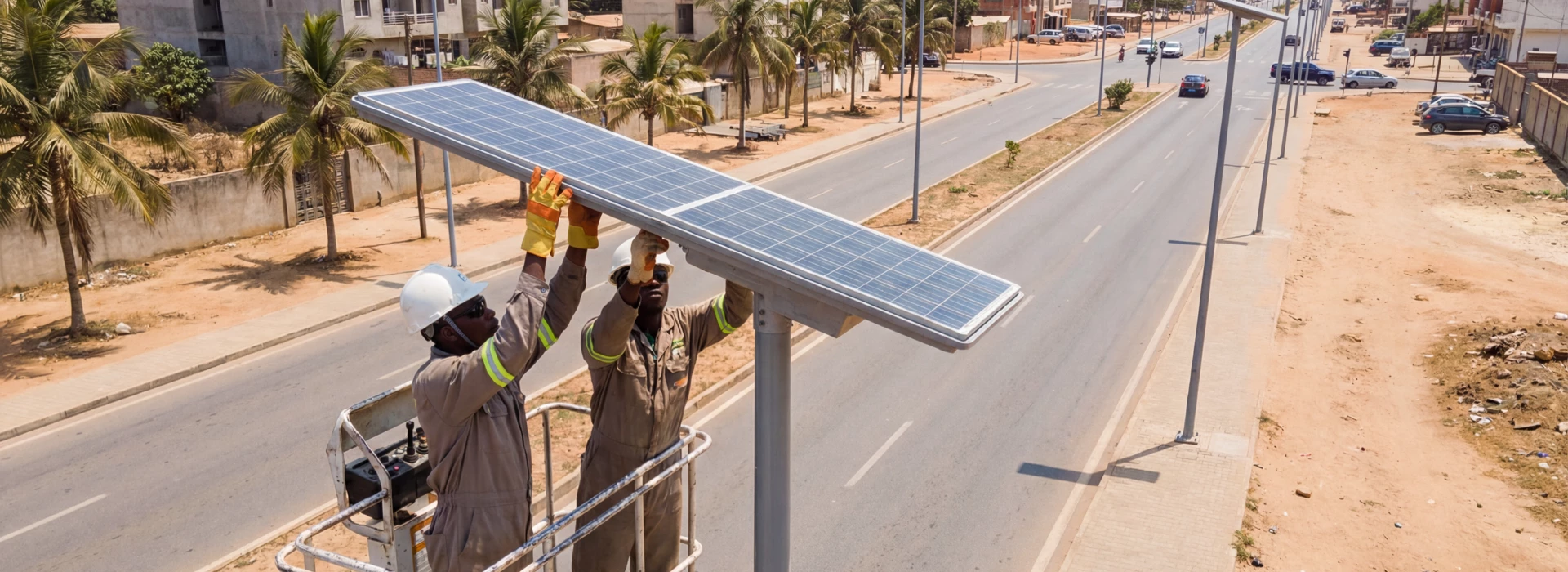
Solar Street Light Installation Guide & FAQ
Installing a solar street lighting system correctly is just as important as selecting the right product.
Proper foundation construction, pole installation, component positioning, and system commissioning directly affect lighting performance, structural safety, and long-term reliability.
This guide answers the most common installation questions while sharing engineering best practices used in municipal, highway, and rural lighting projects across Africa.
Before Installation
👉 Before construction begins, every project should confirm the following information. Site Inspection Checklist:

Installation Process


Best Practices for African Projects
To improve installation quality in African environments, we recommend:
Recommended Installation Tools
A standard installation team should prepare:
Please review the project acceptance checklist before delivery.
Project Installation FAQ
Installation FAQ
How long does it take to install a solar street light?
Installation time depends on project size and foundation curing.
A typical installation includes:
- Foundation construction
- Concrete curing
- Pole erection
- Solar light assembly
- System testing
For experienced installation teams, the pole and luminaire can usually be installed within a few hours after the concrete foundation has fully cured.
Does a solar street light require underground cables?
No.
Most solar street lights operate independently and do not require trenching, underground power cables, or grid connections.
This significantly reduces civil engineering costs and shortens project timelines.
How deep should the pole foundation be?
Foundation dimensions depend on:
- Pole height
- Wind speed
- Soil bearing capacity
- Luminaire weight
Rather than using a universal size, the foundation should be designed according to structural calculations and local site conditions.
How should the solar panel face?
In most African countries, solar panels should be oriented to maximize daily solar exposure and avoid shading from nearby trees, buildings, or other obstacles.
The installation angle should be determined according to the project's geographic location to achieve optimal charging efficiency.
When should the battery be connected?
The battery should only be connected after all electrical connections have been completed and verified.
Please note: Following the manufacturer's installation sequence helps prevent controller errors and protects battery performance.
How is the system tested after installation?
Before project handover, the following items should be inspected:
- Pole verticality
- Tightness of anchor bolts
- Solar panel fixation
- Battery connection
- Controller operation
- LED lighting performance
- Charging status
- Automatic dusk-to-dawn operation
What are the most common installation mistakes?
Common issues include:
- Incorrect pole alignment
- Inadequate concrete curing
- Shading on solar panels
- Loose electrical connections
- Improper foundation dimensions
- Incorrect controller settings
Avoiding these mistakes improves system reliability and reduces maintenance costs.
Can solar street lights be installed during the rainy season?
Yes, provided that foundation work and electrical connections are protected from excessive moisture.
Construction schedules should account for weather conditions, and commissioning should be completed after all components are dry and securely installed.
Need Installation Support for Your Project?
Our engineering team can provide installation drawings, foundation recommendations, wiring guidance, and remote technical support for municipal, highway, and rural lighting projects.
Related Resources
Product Selection Guide
Engineering Design FAQ
Solar Components FAQ
Performance FAQ
Installation FAQ
Africa Projects FAQ
OEM & Distribution
Shipping & Delivery
Warranty & Support
Distributor Cooperation
Project Inquiry
Request a Quote
The messenger of light & power conversion.
© 2026 Queneng Light
 Jason Qiu
Queneng
Queneng
Queneng
Queneng