
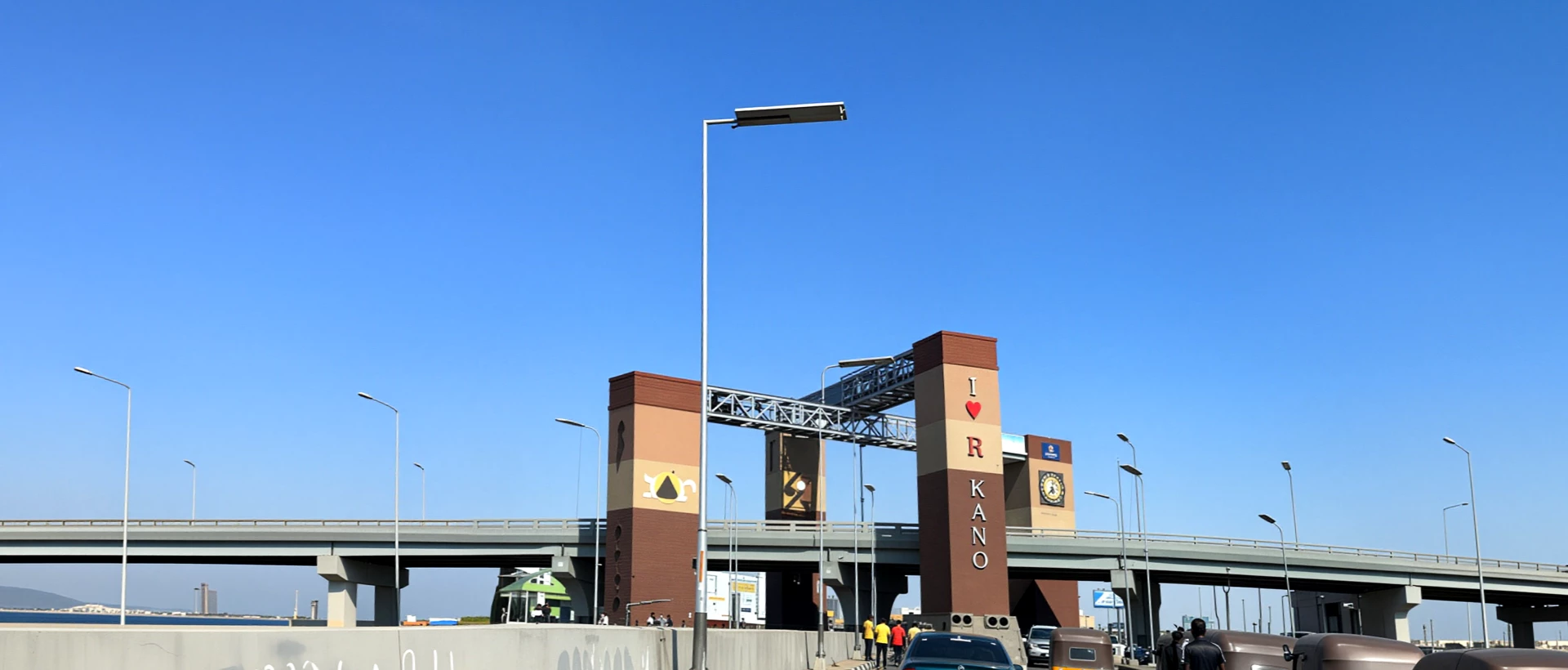
Africa Solar Street Lighting Solutions & Project FAQ
Africa is one of the fastest-growing markets for solar street lighting, but every country and every project has different requirements.
Road classifications, sunshine hours, rainy seasons, ambient temperatures, and infrastructure conditions all influence system design. A solution suitable for an M5 rural road in Kenya may not meet the requirements of an M1 expressway in Nigeria.
This page explains how to select and adapt solar street lighting systems for different African environments and project types.
Why One Solution Doesn't Fit Every Project
Successful projects are based on local conditions rather than standard product specifications.
Before selecting a solar street lighting system, consider:

Engineering design should balance performance, reliability, and lifecycle cost.
Common African Project Environments
| Project Environment | Primary Design Focus |
|---|---|
| Urban Roads | Lighting uniformity and traffic safety |
| Highways | High brightness and long backup time |
| Rural Roads | Cost-effective and low maintenance |
| Coastal Areas | Corrosion resistance |
| Mining & Industrial Zones | High durability and reliability |
| Residential Communities | Comfortable lighting and energy efficiency |

Project Planning Checklist
A complete project assessment helps ensure long-term performance and investment value.
Before starting an African solar street lighting project, confirm the following:
Africa Project FAQ
Africa Projects
Why are solar street lights widely used in Africa?
Many African countries receive abundant solar radiation throughout the year, making solar street lighting an efficient solution for expanding public lighting without relying on unstable power grids.
Solar systems also reduce electricity costs, eliminate underground cable installation, and require less routine maintenance than conventional lighting systems.
How do M1–M5 road classifications affect system selection?
Road classification determines the required lighting performance and system configuration.
- M1–M2: High-speed roads require higher illumination, larger batteries, and greater system redundancy.
- M3: Municipal roads require balanced brightness and energy efficiency.
- M4–M5: Residential and rural roads prioritize reliability, simplified maintenance, and cost-effective operation.
Selecting the correct configuration according to road classification improves both lighting quality and long-term project value.
How should solar street lights be designed for regions with long rainy seasons?
Projects in regions with extended rainy periods should prioritize energy storage and charging efficiency.
Key considerations include:
- Increasing battery autonomy.
- Using high-efficiency solar panels.
- Selecting MPPT controllers.
- Optimizing daily operating profiles.
These measures help maintain reliable lighting even after several consecutive cloudy days.
What should be considered for high-temperature environments?
High ambient temperatures mainly affect battery life and electronic components.
Recommended solutions include:
- LiFePO₄ batteries with excellent thermal stability.
- Well-ventilated battery compartments.
- UV-resistant housing materials.
- Components tested for high-temperature operation.
These measures improve long-term reliability in hot climates.
Are solar street lights suitable for remote rural communities?
Yes.
Solar street lights are particularly suitable for villages, agricultural roads, schools, healthcare centers, and other locations where grid power is unavailable or unreliable.
Their independent operation reduces infrastructure costs while providing safe and dependable nighttime lighting.
How can coastal projects improve system durability?
Salt spray and high humidity accelerate corrosion.
For coastal installations, projects should use:
- Hot-dip galvanized poles.
- Corrosion-resistant fasteners.
- Outdoor-rated electrical connectors.
- High-IP luminaires.
- Durable powder-coated finishes.
These features significantly extend service life in marine environments.
Which African projects benefit most from solar street lighting?
Solar street lighting is widely used in:
- National highways.
- Municipal roads.
- Residential developments.
- Industrial parks.
- Ports and logistics centers.
- Schools and universities.
- Public parks.
- Rural electrification projects.
Each application requires different engineering priorities based on safety, traffic, and maintenance requirements.
Why is local engineering support important for African projects?
Every project has unique technical requirements.
Professional engineering support helps determine the correct system configuration, optimize lighting performance, reduce lifecycle costs, and ensure the project meets local road lighting standards and client expectations.
View Our Solar Street Light Projects in Africa
We have completed numerous projects across Africa, all of which have been customized to withstand the region’s harsh climatic conditions. We offer real-world examples of municipal and rural lighting solutions. Browse our case studies to discover proven solutions that will help you with your bids and bulk orders.


Planning a Solar Street Lighting Project in Africa?
Whether your project is located on an M1 highway, an M3 municipal road, or an M5 rural access road, our engineering team can recommend a solution based on local conditions, road classification, and project objectives.
Related Resources
Product Selection Guide
Engineering Design FAQ
Solar Components FAQ
Performance FAQ
Installation FAQ
Africa Projects FAQ
OEM & Distribution
Shipping & Delivery
Warranty & Support
Distributor Cooperation
Project Inquiry
Request a Quote
The messenger of light & power conversion.
© 2026 Queneng Light
 Jason Qiu
Queneng
Queneng
Queneng
Queneng