
Lagos, Nigeria Urban Municipal Road Solar Lighting Project – 1,400 Sets of QN-YY160 60W Intelligent Solar Street Lights Installed in 2025
Lagos, Nigeria
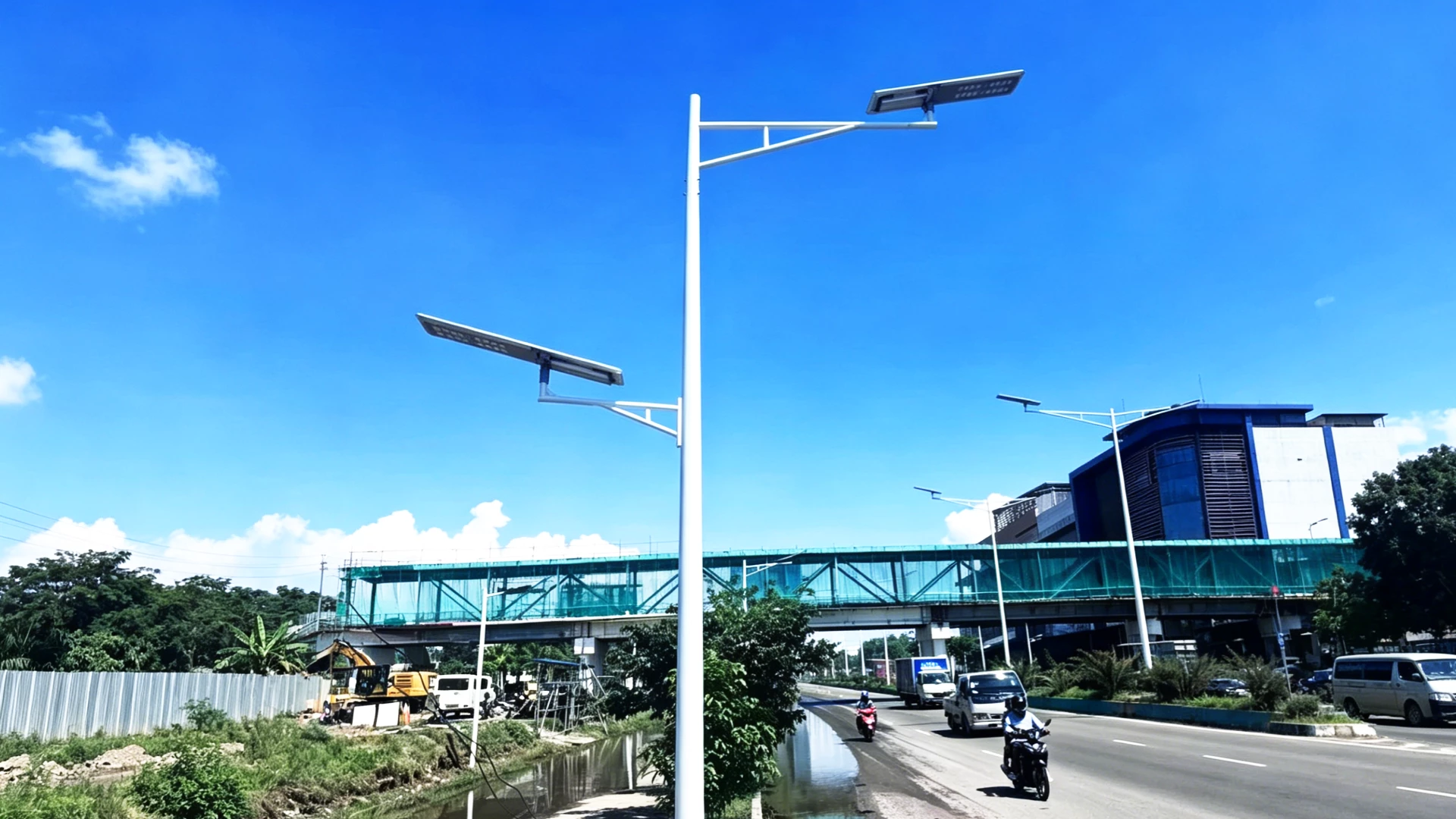
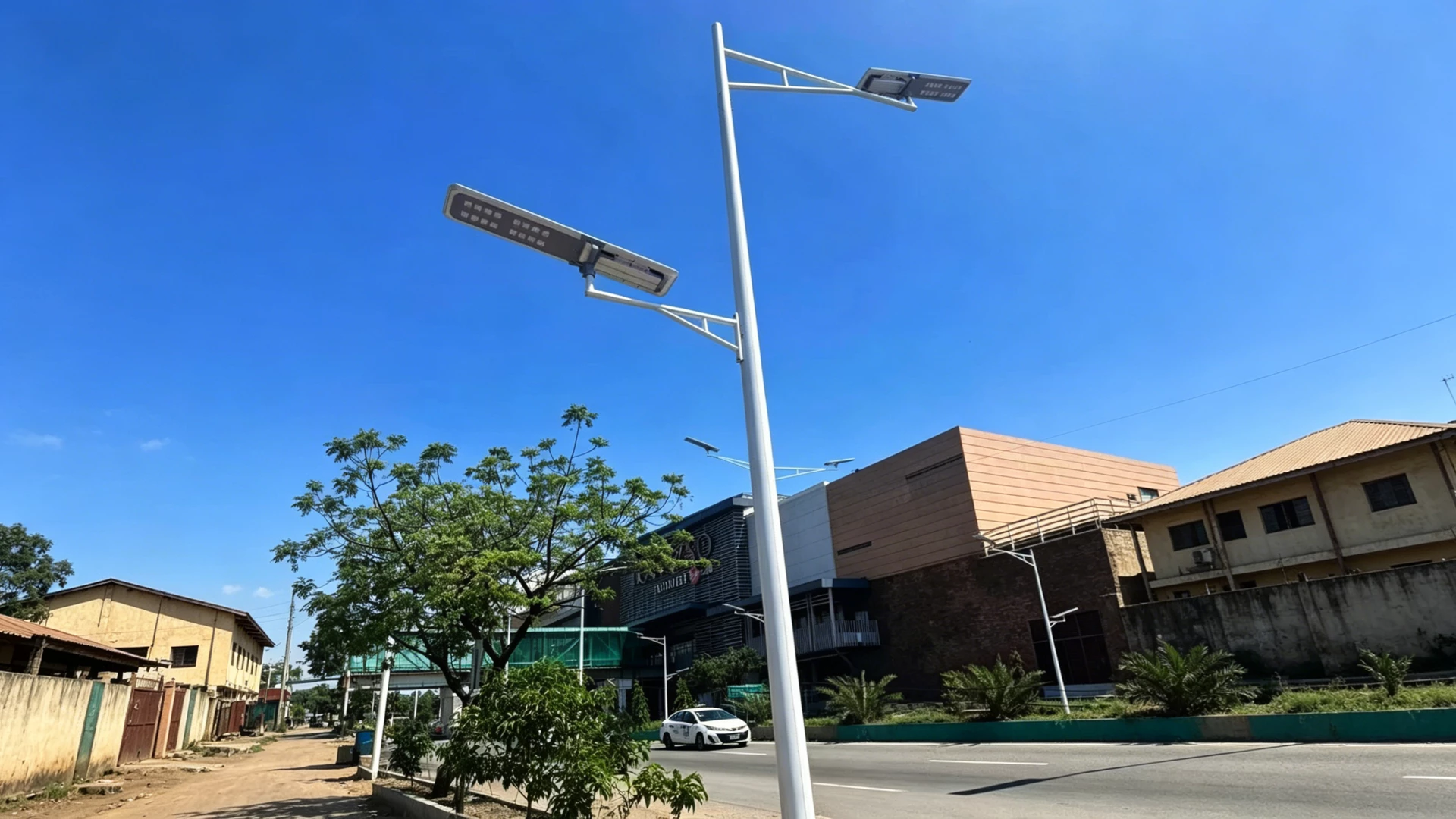
In August 2025, a municipal infrastructure engineering contractor from Lagos partnered with Queneng Lighting to deploy 1,400 sets of the QN-YY160 eco-friendly solar street light for large-scale urban municipal road lighting upgrades across several key transportation corridors. The project was designed to improve nighttime road visibility, reduce municipal electricity consumption, lower long-term maintenance costs, and provide stable illumination performance during Nigeria’s rainy seasons and unstable grid conditions.

Project Background
As one of the fastest-growing metropolitan areas in Africa, Lagos faces increasing pressure on urban infrastructure development, especially in transportation and public lighting systems. Many traditional street lighting systems suffer from unstable power supply, expensive electricity costs, aging cables, and high maintenance frequency.
Project Overview
- 1400 sets installed
- Urban municipal roadway deployment
- All-in-One solar street lighting system
- Rainy-season optimized battery configuration
- 8m galvanized poles
Project Challenges
- Heavy rainy season
- High traffic density
- Long operational requirements
- Municipal maintenance considerations
Solution Provided
- Intelligent MPPT charging system
- High-efficiency solar panels
- Long backup lithium battery configuration
- Anti-corrosion outdoor structure
After comparing multiple suppliers and evaluating technical specifications, the client selected the QN-YY160 All-in-One Solar Street Light from QUENENG Lighting due to its integrated intelligent control system, LiFePO₄ battery technology, high-efficiency monocrystalline solar panel, and strong waterproof outdoor design.
Why the Client Chose the All-in-One Solar Street Light QN-YY160
1. Intelligent MPPT Energy Management System
The QN-YY160 integrates Queneng’s MPPT intelligent power management technology, which automatically adjusts energy allocation according to weather conditions and battery capacity. This feature allows continuous lighting performance during cloudy and rainy days.
For municipal road projects in tropical climates like Nigeria, stable rainy-season operation is a critical requirement.
2. High-Efficiency Monocrystalline Solar Panel
The project adopted high-conversion monocrystalline silicon solar panels for faster daytime charging efficiency and better energy collection performance under unstable sunlight conditions.
Advantages include:
- Faster charging speed
- Better cloudy-day performance
- Higher energy conversion efficiency
- Longer service lifespan
3. Automotive-Grade LiFePO₄ Lithium Battery
Battery quality is one of the most important factors in solar street light projects. The QN-YY160 uses automotive-grade LiFePO₄ batteries with excellent cycle stability and high-temperature resistance.
Key benefits include:
- Longer battery lifespan
- Stable discharge performance
- Safer battery chemistry
- Better thermal stability
- Reduced maintenance frequency
4. Professional Roadway Optical Lens Design
The QN-YY160 solar street light uses a 70° × 150° roadway optical lens specifically designed for municipal roads and traffic illumination applications.
This professional optical distribution helps achieve:
- Wider road coverage
- More uniform illumination
- Reduced glare
- Improved road visibility
- Better spacing efficiency between poles
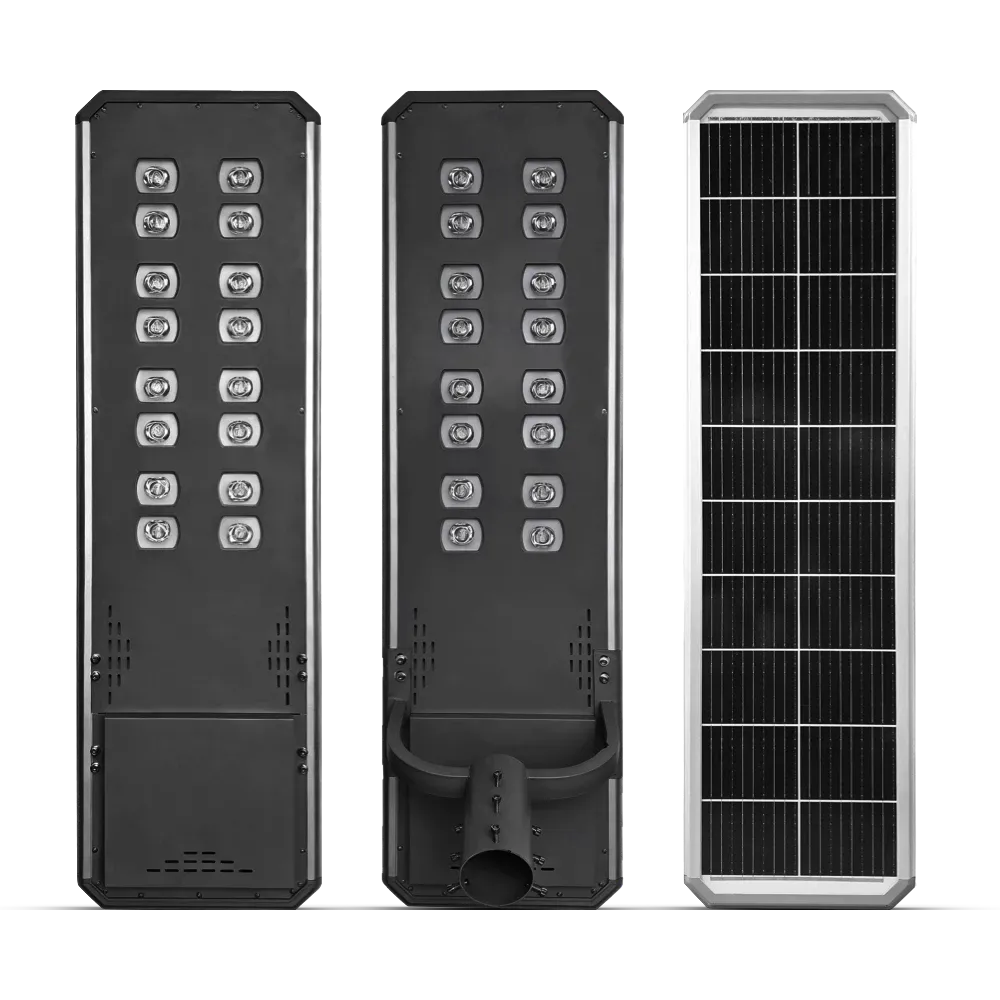
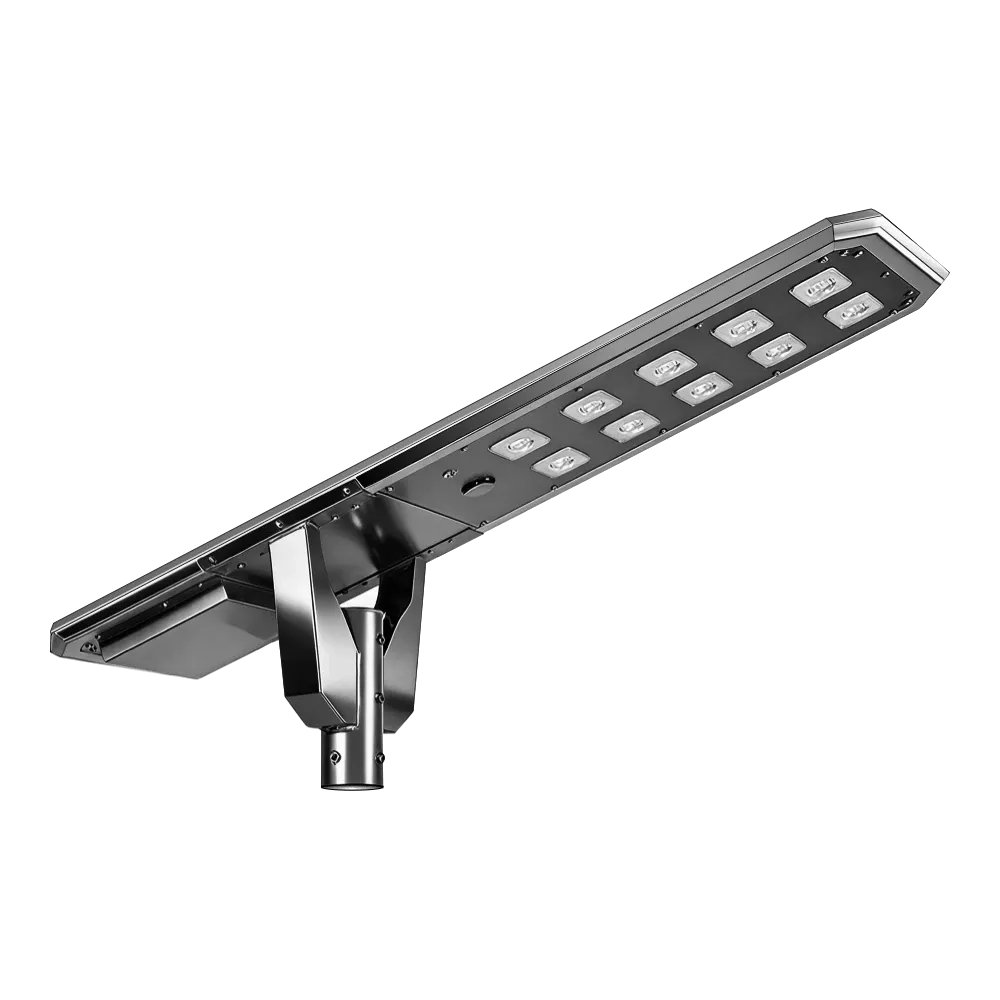
Product Specifications Used in This Project
The Lagos project mainly adopted the customized 60W municipal road configuration.
| Item | Specification |
|---|---|
| Product Model | QN-YY160 All-in-One Solar Street Light |
| Lighting Power | 60W |
| LED Chips | 5054 SMD LED Chips |
| Luminous Flux | 5000 lm |
| Solar Panel | 5V 60W Monocrystalline Panel |
| Battery Type | 3.2V 70Ah LiFePO₄ Battery |
| Optical Lens | 70° × 150° Roadway Optical Lens |
| Control System | Light Control + Radar Sensing + Intelligent Dimming |
| Waterproof Rating | IP65 |
| Material | Die-Cast Aluminum |
| Charging Time | 5–6 Hours |
| Backup Time | 2–3 Rainy Days |
| Recommended Pole Height | 6–8 Meters |
| Installation Type | Pole-mounted |
Technical specifications are referenced from official product documentation.
Installation Process
The installation project was completed in multiple phases to ensure traffic flow was not interrupted during construction.
Phase 1 – Site Survey & Lighting Design
The engineering team analyzed:
- Road width
- Pole spacing
- Vehicle traffic conditions
- Illumination requirements
- Installation angles
- Battery backup requirements
Lighting simulations were used to optimize lamp spacing and ensure consistent road brightness.
Phase 2 – Pole Preparation & Foundation Work
Galvanized steel poles were installed along major municipal roads with reinforced foundations suitable for long-term outdoor operation in tropical environments.
Phase 3 – Solar Street Light Assembly
Each QN-YY160 solar street light was pre-assembled before shipment, significantly reducing on-site installation time.
The integrated all-in-one structure helped simplify:
- Wiring
- Solar panel installation
- Battery integration
- Controller setup
Phase 4 – System Testing & Commissioning
Before final handover, every lighting section underwent:
- Charging performance testing
- Nighttime illumination inspection
- Radar sensing verification
- Waterproof inspection
- Lighting stability testing
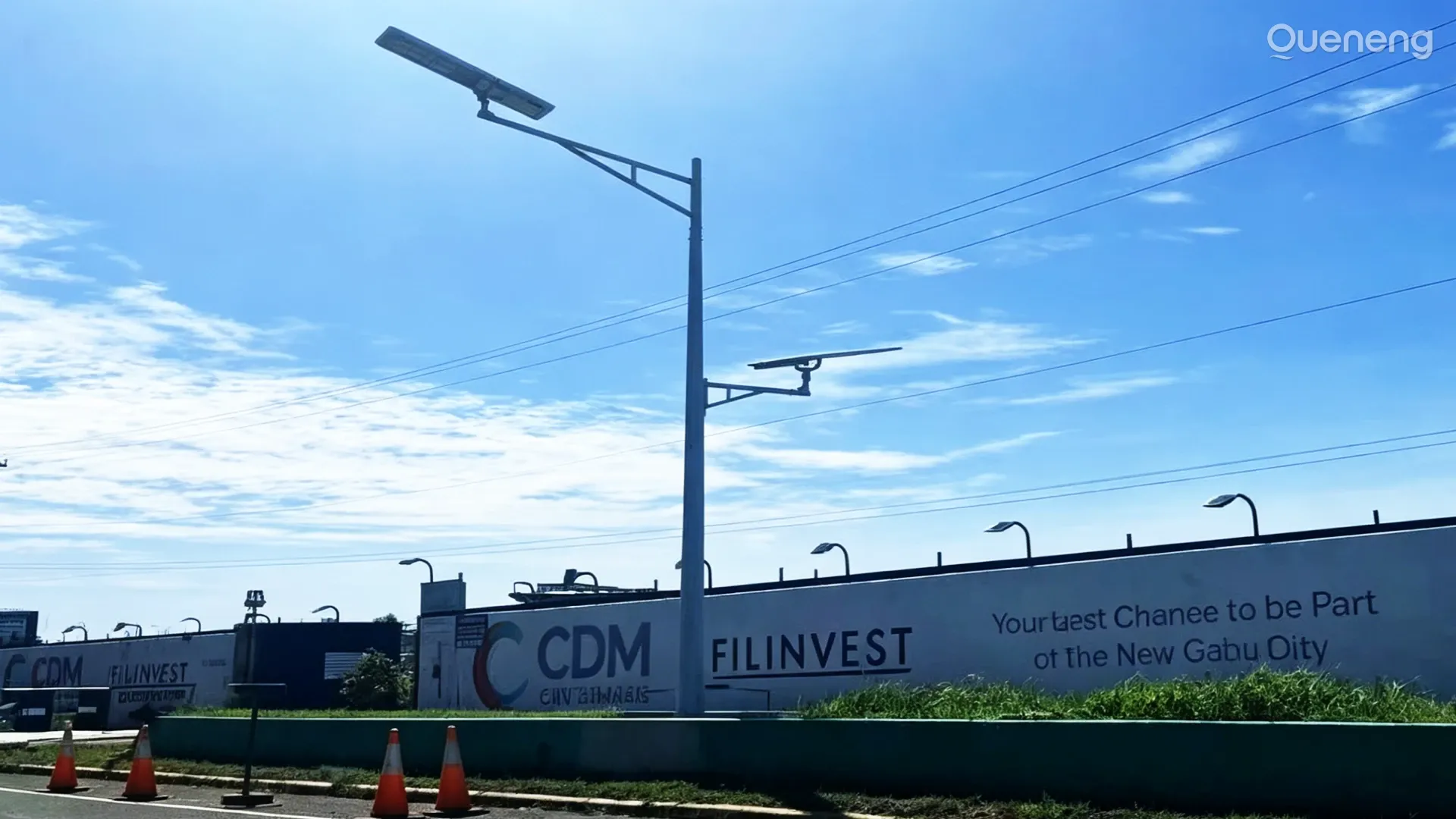
Project Results
After project completion, the municipal roads achieved significant improvements in nighttime visibility and energy efficiency.
Key Project Benefits
Improved Road Safety
Uniform LED road illumination significantly enhanced nighttime driving visibility and pedestrian safety.
Reduced Municipal Electricity Costs
The off-grid solar lighting system eliminated dependence on unstable utility electricity infrastructure.
Lower Maintenance Requirements
The integrated all-in-one structure reduced cable failures and simplified future maintenance work.
Faster Installation Efficiency
Compared with traditional wired lighting systems, installation time was greatly reduced due to the wireless solar-powered design.
Environmentally Friendly Urban Infrastructure
The project supports sustainable urban development goals by reducing carbon emissions and electricity consumption.
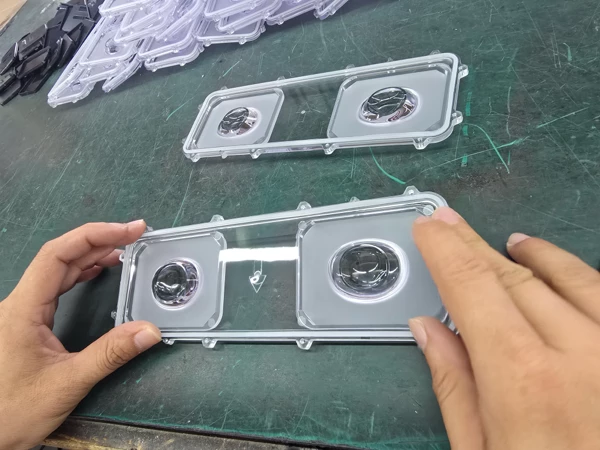
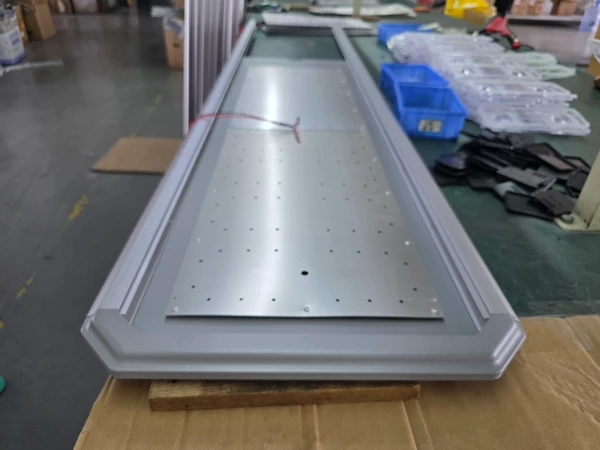
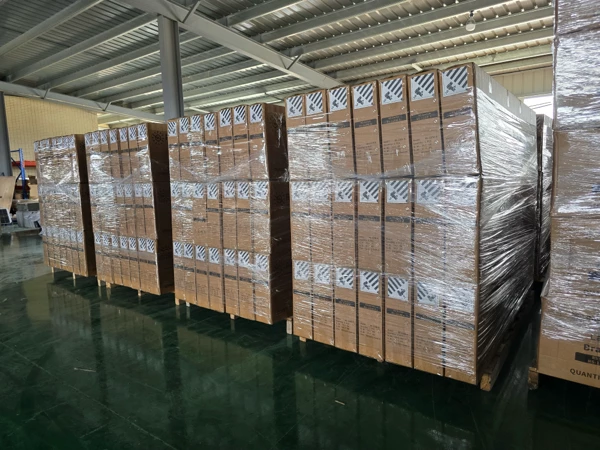
Queneng's Strict Production & Quality Inspection Process
Before shipment, every QN-YY160 solar street light undergoes strict production and quality inspection procedures to ensure long-term outdoor reliability.
1. Raw Material Inspection
All incoming materials including:
- LED chips
- Solar panels
- Lithium batteries
- Aluminum housings
- Controllers
are inspected before production.
2. LED Module Assembly
High-brightness LED modules are assembled and tested for:
- Luminous efficiency
- Color temperature consistency
- Heat dissipation performance
3. Battery Integration Testing
Each LiFePO₄ battery pack undergoes:
- Capacity testing
- Charging/discharging inspection
- Voltage stability testing
- Safety verification
4. Waterproof & Aging Tests
All products undergo:
- IP65 waterproof testing
- Continuous lighting aging tests
- Rain simulation testing
- Outdoor durability inspection
5. Final Brightness & Function Inspection
Before packaging, every lamp is checked for:
- Intelligent control operation
- Motion sensing functionality
- Charging performance
- Lighting consistency
- Structural stability
Customer Feedback
The Lagos engineering contractor reported high satisfaction with the project performance after installation.
Key feedback included:
- Stable nighttime brightness
- Excellent rainy-season operation
- Faster installation efficiency
- Lower operating costs
- Strong product appearance and build quality
- Reliable intelligent dimming performance
The customer also indicated plans for future expansion projects using Queneng solar street lighting systems.
FAQ
What roads are suitable for the QN-YY160 solar street light?
The QN-YY160 is suitable for:
- Municipal roads
- Urban streets
- Highways
- Industrial parks
- Residential communities
- Parking lots
- Rural roads
- Campus roads
Can the solar street light work during rainy days?
Yes. The built-in MPPT intelligent management system automatically optimizes energy allocation and supports continuous operation during multiple rainy days.
What battery technology is used?
The system uses automotive-grade LiFePO₄ lithium batteries with high safety, long lifespan, and excellent thermal stability.
Is installation complicated?
No. The all-in-one integrated structure simplifies installation and reduces wiring work significantly.
What waterproof rating does the product have?
The QN-YY160 solar street light adopts an IP65 waterproof design suitable for outdoor municipal applications.
Request a quote for the product configuration for this project
Please let us know your specific application scenario and product requirements—we will send you a detailed product specification list and a reference quote within 24 hours.
Latest Updates Related to This Project

How to Choose the Right Solar Street Light System
Choosing the right solar street light system is essential for achieving reliable outdoor lighting performance, long battery lifespan, and stable nighttime illumination.
Whether the project is for municipal roads, highways, industrial parks, villages, commercial spaces, or public infrastructure, selecting the proper solar street lighting configuration directly affects energy efficiency, installation costs, maintenance requirements, and long-term operational stability.
This guide explains the key factors that should be considered when choosing a solar street lighting system for different outdoor applications and environmental conditions.

Solar Street Light Cost Analysis and ROI Guide
For many years, solar street lighting was often viewed as a niche solution mainly used in remote villages or small off-grid applications.
That perception has changed rapidly.
Today, solar street lighting systems are being deployed across municipal roads, highways, industrial parks, residential communities, mining areas, and large-scale infrastructure projects worldwide.
The reason is no longer only environmental sustainability.
It is economics.
As electricity prices continue rising and infrastructure construction becomes more expensive, governments, contractors, and developers are paying closer attention to long-term operational costs instead of simply comparing upfront equipment pricing.
And this is where solar street lighting starts becoming financially attractive.
At first glance, many buyers still assume solar street lights are expensive.
After all, a complete system includes:
- • solar panels
- • lithium batteries
- • LED fixtures
- • intelligent controllers
- • structural mounting systems
Compared to a conventional street lamp fixture alone, the initial quotation may appear significantly higher.
But experienced infrastructure planners rarely evaluate a project based only on fixture cost.
Because in real-world roadway projects, the lighting fixture is often only a small part of the total investment.

MPPT vs PWM Controllers for Solar Street Lighting Systems
The solar charge controller is one of the most critical components in a solar street lighting system. It directly affects charging efficiency, battery lifespan, and system reliability.
Two commonly used technologies are MPPT (Maximum Power Point Tracking) and PWM (Pulse Width Modulation) controllers.
This article explains their differences and helps you choose the right solution for solar street lighting projects.

Solar Street Light Installation Guide for Roads and Infrastructure Projects
Installing solar street lights is often described as a straightforward process.
On paper, it looks simple: assemble the pole, fix the solar panel, connect the battery, and test the system.
But in real infrastructure projects, installation is rarely that clean.
Once engineers arrive on site, they are usually dealing with uneven road conditions, unexpected shading issues, unstable soil for foundations, transportation limitations, and last-minute design adjustments based on actual field conditions.
This is why installation quality often determines the real lifespan and performance of a solar street lighting system more than product specifications alone.
A well-designed system can still perform poorly if installation is not handled correctly. On the other hand, a properly installed system can often outperform expectations even in challenging environments.
You might also be interested in our other latest projects.

Owerri City Main Road Solar Lighting Project Case Study | 1,500 Sets Efficient LED Solar Street Lights Installed in Nigeria
In May 2025, a professional municipal engineering contractor from Owerri partnered with QUENENG Lighting to upgrade the nighttime lighting infrastructure of several major urban roads and traffic corridors.
After evaluating multiple solar street light suppliers and comparing long-term operational costs, the client selected the Efficient LED Solar Street Light series for its combination of high luminous efficiency, intelligent energy management, durable outdoor structure, and low maintenance requirements.
The project involved the deployment of 1,500 sets of integrated solar LED street lights across major roadways, intersections, and public transportation routes in Owerri City, Nigeria.
The selected product model:
Luyi Advanced LED Outdoor Lighting with Solar Power Solar Street Light
The installation significantly improved nighttime visibility, traffic safety, pedestrian security, and urban infrastructure sustainability while reducing dependence on unstable grid electricity.
Looking to replicate this successful installation?
Inspired by this solar lighting project? Queneng Light can help you implement a similar solution tailored to your location, climate, and application requirements.
Contact us to receive detailed technical specifications, system recommendations, and a cost-effective proposal based on your project scale.
The messenger of light & power conversion.
© 2026 Queneng Light
 Jason Qiu
Queneng
Queneng
Queneng
Queneng