
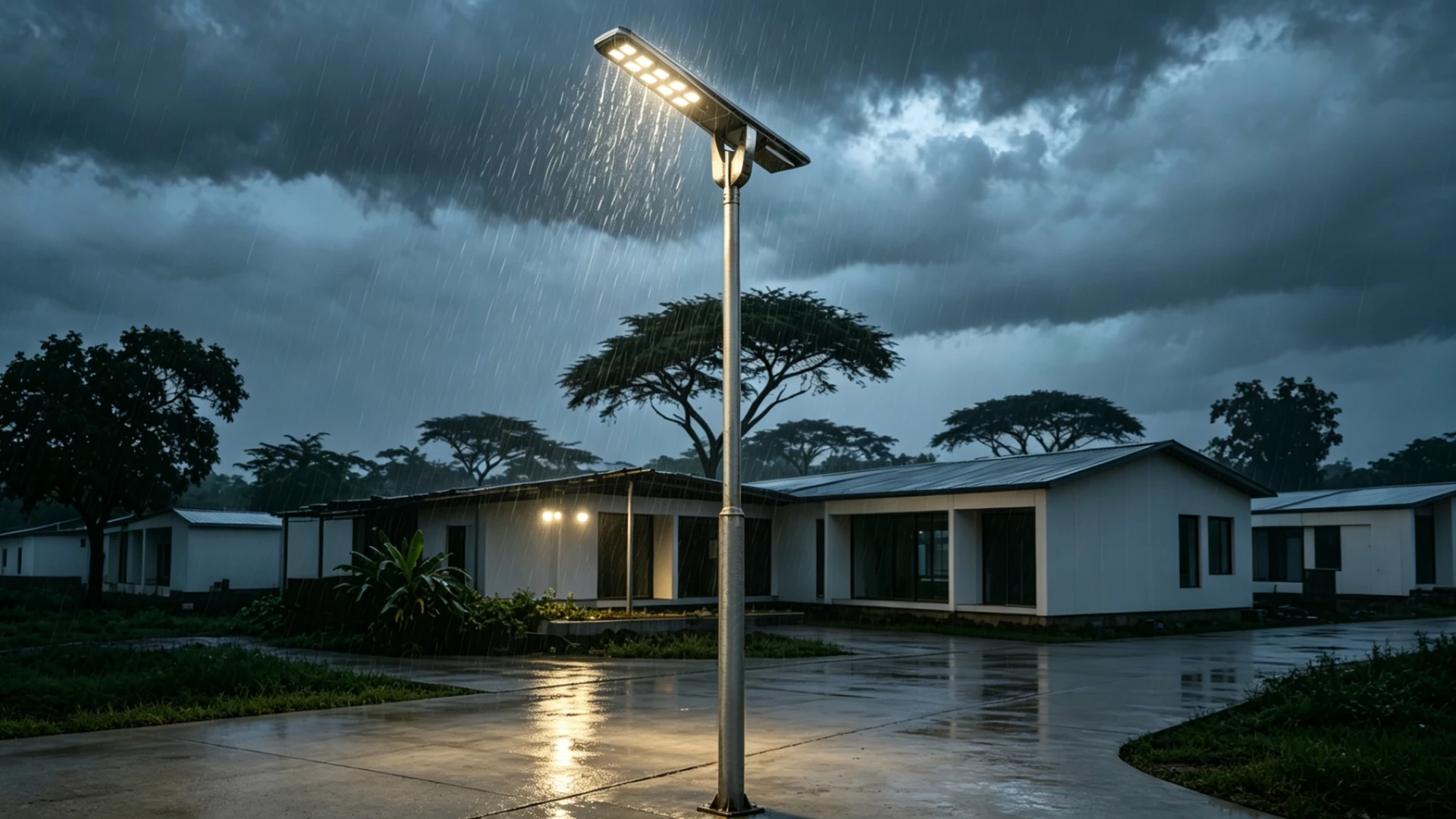

Installing solar street lights is often described as a straightforward process.
On paper, it looks simple: assemble the pole, fix the solar panel, connect the battery, and test the system.
But in real infrastructure projects, installation is rarely that clean.
Once engineers arrive on site, they are usually dealing with uneven road conditions, unexpected shading issues, unstable soil for foundations, transportation limitations, and last-minute design adjustments based on actual field conditions.
This is why installation quality often determines the real lifespan and performance of a solar street lighting system more than product specifications alone.
A well-designed system can still perform poorly if installation is not handled correctly. On the other hand, a properly installed system can often outperform expectations even in challenging environments.
- Site Conditions Are More Important Than the Product Itself
- Foundation Work Determines Long-Term Stability
- Installation Sequence Is Not Always Linear on Site
- Electrical Connection Requires More Attention Than Physical Assembly
- System Testing Is Where Real Performance Becomes Visible
- Common Installation Mistakes in Real Projects
- Why Professional Installation Matters for ROI
- Conclusion
- FAQ
Site Conditions Are More Important Than the Product Itself
Before any physical installation of solar street lights begins, experienced engineers usually spend more time on site evaluation than on actual assembly work.
Because once poles are fixed and foundations are poured, adjustments become expensive and sometimes impossible.
One of the most common issues encountered in field projects is unexpected shading.
Trees, nearby buildings, signage structures, or even future construction plans can affect solar panel exposure. In some cases, a perfectly designed system on paper underperforms simply because it does not receive consistent sunlight throughout the day.
Another overlooked factor is road orientation.
East-west and north-south-facing roads can produce different lighting and charging conditions, which directly impacts panel angle design and pole positioning.
So while installation is often seen as a construction task, in reality it starts with environmental interpretation.

Foundation Work Determines Long-Term Stability
If there is one stage that should never be rushed, it is the foundation.
In many field projects, installation problems do not come from electrical components but from structural instability caused by poor foundation preparation.
Soil conditions vary significantly between regions. Some areas have compact soil suitable for standard concrete bases, while others require deeper foundations due to loose or sandy terrain.
Wind load is another critical factor that is often underestimated.
Solar street lights act like vertical structures with wind-catching surfaces due to solar panels mounted at the top. If foundation depth and reinforcement are not properly calculated, long-term structural tilting or instability can occur.
In coastal or high-wind regions, engineers usually increase anchor bolt depth and concrete strength to ensure long-term durability.
This part of installation is not visible after completion, but it defines how the system behaves over years of operation.
Installation Sequence Is Not Always Linear on Site
Although installation manuals usually describe a fixed sequence, real-world conditions often require flexibility.
For example, in some projects, pole installation may need to be delayed until transportation logistics are completed for heavier crane equipment. In others, solar panel mounting may be adjusted on-site due to unexpected angle optimization requirements.
A typical installation sequence includes:
- foundation preparation and curing
- pole erection and alignment
- solar panel mounting and angle adjustment
- battery and controller connection
- LED fixture installation
- system activation and testing
However, experienced installation teams rarely follow this order rigidly.
Instead, they adapt based on weather conditions, traffic restrictions, manpower availability, and on-site safety requirements.
This flexibility is one of the key differences between standard installation teams and professional infrastructure contractors.

Electrical Connection Requires More Attention Than Physical Assembly
Unlike traditional street lighting systems, solar street lights rely heavily on internal electrical integration.
While the system is designed to be “plug-and-play” in theory, improper wiring is still one of the most common causes of system failure.
Battery polarity errors, loose connector sealing, or insufficient waterproof insulation can lead to performance instability over time.
In many cases, the system may function correctly on the first day but fail after exposure to heavy rain or humidity cycles.
This is why experienced engineers always treat electrical connection as a sealing process rather than just wiring.
Every connection point must be checked not only for conductivity but also for long-term environmental protection.
System Testing Is Where Real Performance Becomes Visible
Once installation is complete, the system testing phase reveals whether the project has been executed properly.
This stage is not just about checking whether the light turns on.
It is about verifying system behavior under real environmental conditions.
Engineers typically observe:
- charging efficiency during daytime exposure
- lighting duration during nighttime operation
- automatic switching sensitivity
- brightness stability over time
- battery discharge consistency
In some projects, adjustments are still made at this stage, especially for controller settings or lighting duration configuration.
This is also the moment where differences between design expectations and real-world performance become clear.
Common Installation Mistakes in Real Projects
Even experienced teams encounter issues when dealing with large-scale deployments.
Some of the most common problems include:
- Inadequate solar panel orientation adjustment, which reduces charging efficiency over time.
- Insufficient foundation depth, which leads to structural tilting in high-wind environments.
- Poor waterproof sealing at connection points, which causes long-term electrical instability.
- Incorrect battery compartment sealing, especially in humid or coastal regions.
These issues are rarely catastrophic on day one, but they gradually affect system reliability over months or years.
Why Professional Installation Matters for ROI
Installation is often underestimated in cost calculations, but it directly affects long-term return on investment.
A high-quality solar street lighting system can still underperform if installed incorrectly.
Conversely, a properly installed system reduces maintenance frequency, improves energy efficiency, and extends overall system lifespan.
For municipal and infrastructure projects, installation quality is not just a construction detail.
It is a financial factor that influences long-term operational cost.
Conclusion
Solar street light installation is not simply an assembly process.
It is a combination of site analysis, structural engineering, electrical integration, and long-term performance planning.
The difference between a basic installation and a professional installation is often not visible immediately after completion but becomes clear over time through system stability and maintenance frequency.
For infrastructure projects, especially those deployed across large road networks, installation quality is one of the most important factors determining the real success of the entire lighting system.
FAQ
1. How are solar street lights installed?
Solar street lights are typically installed through several key stages, including site inspection, foundation preparation, pole installation, solar panel mounting, electrical connection, and final system testing.
Unlike traditional street lights, solar systems operate independently and usually do not require underground electrical wiring or grid connection.
However, installation quality still plays a critical role in long-term lighting performance and structural stability.
2. Do solar street lights require underground wiring?
No. Most solar street lighting systems are designed as independent off-grid units.
Each system generates and stores its own energy through solar panels and battery systems, eliminating the need for underground trenching, cable routing, and external electrical infrastructure.
This significantly simplifies installation for roads, highways, rural areas, and infrastructure projects.
3. How deep should the foundation for a solar street light be?
Foundation depth depends on multiple factors, including:
- pole height
- wind load
- soil condition
- local climate
- lighting system weight
For larger roadway projects or high-wind environments, deeper reinforced concrete foundations are typically required to ensure long-term structural stability.
Professional engineering evaluation is recommended before installation.
4. What is the best angle for solar panel installation?
The optimal solar panel angle depends on geographic location, sunlight exposure, and seasonal weather conditions.
In most outdoor lighting projects, the panel is adjusted to maximize daily solar energy absorption while minimizing shading impact.
Improper panel angle installation can reduce charging efficiency and affect nighttime lighting performance.
5. How long does it take to install a solar street light?
Installation time varies depending on project scale and site conditions.
For standard projects, a single solar street light can often be installed within 30 to 60 minutes after foundation curing is completed.
Large infrastructure projects may require additional time for civil engineering, transportation coordination, and system testing.
6. Can solar street lights be installed in areas with heavy rain?
Yes. Professional solar street lighting systems are designed for outdoor operation in various environmental conditions, including heavy rain and humid climates.
High-quality systems usually include:
- IP65 waterproof protection
- corrosion-resistant housing
- sealed battery compartments
- outdoor-grade electrical connections
- Proper waterproof installation is essential for long-term reliability.
7. Why is site inspection important before installation?
Site inspection helps engineers identify potential issues before construction begins.
This includes:
- sunlight exposure analysis
- shading obstacles
- road orientation
- soil conditions
- installation access
- wind exposure
A poorly selected installation location can reduce charging efficiency and shorten system performance lifespan.
8. What are the most common solar street light installation mistakes?
Common installation issues include:
- incorrect solar panel angle
- insufficient foundation depth
- poor waterproof sealing
- unstable pole alignment
- loose electrical connections
- improper battery compartment protection
Many of these problems may not appear immediately after installation but gradually affect system stability over time.
9. Do solar street lights require professional installation teams?
For small community projects, installation may be relatively simple.
However, for municipal roads, highways, industrial parks, and large infrastructure projects, professional installation teams are strongly recommended.
Experienced engineers help ensure:
- structural safety
- proper electrical integration
- optimal panel positioning
- long-term system reliability
10. How do engineers test solar street lights after installation?
After installation, engineers usually perform system testing to verify:
- daytime charging performance
- nighttime lighting duration
- automatic on/off operation
- battery charging status
- controller functionality
- lighting stability
Testing helps identify configuration issues before project delivery.
11. Can solar street lights be installed in remote areas?
Yes. Solar street lights are especially suitable for remote regions where utility grid access is unavailable or expensive.
Because the systems operate independently, they are widely used in:
- rural roads
- highways
- mining areas
- villages
- industrial development zones
Installation is usually faster and less dependent on electrical infrastructure compared to traditional lighting systems.
12. Why does installation quality affect long-term ROI?
Improper installation can lead to:
- structural instability
- charging inefficiency
- water leakage
- battery damage
- higher maintenance frequency
A professionally installed solar street lighting system typically achieves better operational stability and lower long-term maintenance cost, which directly improves return on investment over time.
Get a Configuration Quote
Please let us know your specific application scenario and product requirements—we will send you a detailed product specifications list and a reference quote within 24 hours.
Products related to this blog

How to Choose the Right Solar Street Light System
Choosing the right solar street light system is essential for achieving reliable outdoor lighting performance, long battery lifespan, and stable nighttime illumination.
Whether the project is for municipal roads, highways, industrial parks, villages, commercial spaces, or public infrastructure, selecting the proper solar street lighting configuration directly affects energy efficiency, installation costs, maintenance requirements, and long-term operational stability.
This guide explains the key factors that should be considered when choosing a solar street lighting system for different outdoor applications and environmental conditions.

Solar Street Light Cost Analysis and ROI Guide
For many years, solar street lighting was often viewed as a niche solution mainly used in remote villages or small off-grid applications.
That perception has changed rapidly.
Today, solar street lighting systems are being deployed across municipal roads, highways, industrial parks, residential communities, mining areas, and large-scale infrastructure projects worldwide.
The reason is no longer only environmental sustainability.
It is economics.
As electricity prices continue rising and infrastructure construction becomes more expensive, governments, contractors, and developers are paying closer attention to long-term operational costs instead of simply comparing upfront equipment pricing.
And this is where solar street lighting starts becoming financially attractive.
At first glance, many buyers still assume solar street lights are expensive.
After all, a complete system includes:
- • solar panels
- • lithium batteries
- • LED fixtures
- • intelligent controllers
- • structural mounting systems
Compared to a conventional street lamp fixture alone, the initial quotation may appear significantly higher.
But experienced infrastructure planners rarely evaluate a project based only on fixture cost.
Because in real-world roadway projects, the lighting fixture is often only a small part of the total investment.

MPPT vs PWM Controllers for Solar Street Lighting Systems
The solar charge controller is one of the most critical components in a solar street lighting system. It directly affects charging efficiency, battery lifespan, and system reliability.
Two commonly used technologies are MPPT (Maximum Power Point Tracking) and PWM (Pulse Width Modulation) controllers.
This article explains their differences and helps you choose the right solution for solar street lighting projects.
Tailored Solar Street Light Solutions for Your Projects
Request Installation Consultation
View more of our products suitable for installation in African countries and regions.

30W–120W All-in-One Solar Street Light for Residential & Rural Roads | QN-YY
QN-YY is a compact all-in-one solar street light solution developed by Queneng for decentralized outdoor lighting applications.
Combining a high-efficiency solar panel, LED lighting module, LiFePO₄ battery, and intelligent controller into one integrated unit, QN-YY simplifies installation while providing reliable illumination performance for residential roads, rural communities, pathways, and small infrastructure projects.
The QN-YY is available with multiple configurations, including QN-YY130, QN-YY140, QN-YY160, QN-YY180, and QN-YY1110, allowing project developers to select suitable power options according to road width, installation height, and lighting requirements.
The messenger of light & power conversion.
© 2026 Queneng Light
 Jason Qiu
Queneng
Queneng
Queneng
Queneng