
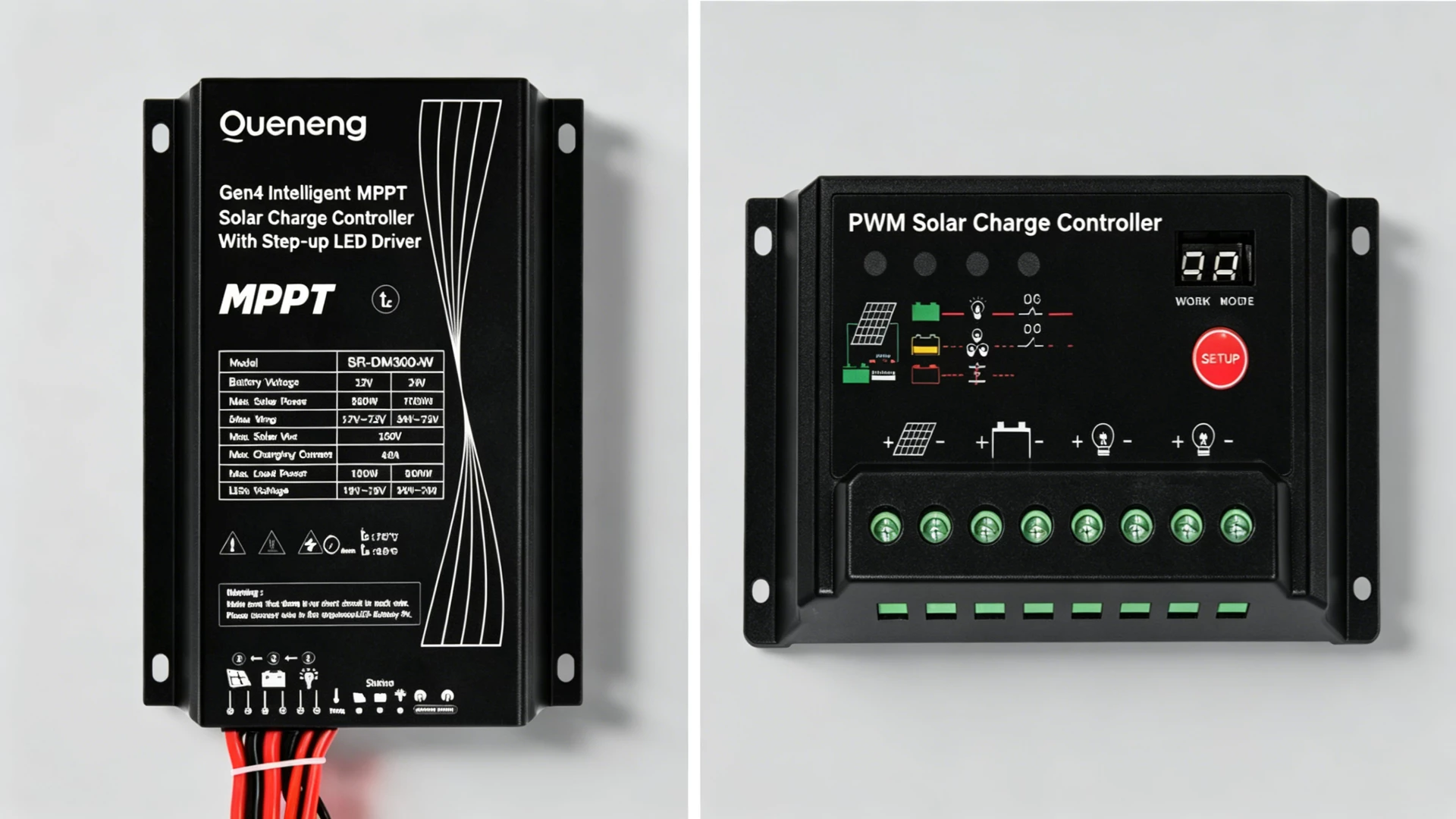

The solar charge controller is one of the most critical components in a solar street lighting system. It directly affects charging efficiency, battery lifespan, and system reliability.
Two commonly used technologies are MPPT (Maximum Power Point Tracking) and PWM (Pulse Width Modulation) controllers.
This article explains their differences and helps you choose the right solution for solar street lighting projects.
What is a PWM controller?
PWM is a traditional solar charging method that directly connects the solar panel to the battery.
Characteristics:
- Lower cost
- Simple structure
- Basic charging control
- Limited efficiency in low sunlight
Limitation:
PWM cannot fully extract solar energy from panels, especially in cloudy or low-light conditions.
What is an MPPT controller?
MPPT technology continuously tracks the maximum power point of the solar panel.
Advantages:
- Higher energy conversion efficiency (up to 30% more)
- Better performance in cloudy weather
- Faster battery charging
- Improved system stability


Key Differences
| Feature | MPPT | PWM |
|---|---|---|
| Efficiency | High | Medium |
| Cost | Higher | Lower |
| Battery Protection | Advanced | Basic |
| Low-light Performance | Excellent | Weak |
Which is Better for Solar Street Lights?
For modern solar street lighting systems, MPPT is recommended because:
- It increases energy harvest
- Improves rainy-day performance
- Extends battery lifespan
- Reduces maintenance frequency
PWM is only suitable for low-budget or small-scale lighting projects.
Need Professional Solar Street Lighting Solutions?
Both MPPT and PWM controllers can be used in solar street lighting systems, but their performance, charging efficiency, and long-term reliability are significantly different.
PWM controllers remain a practical solution for small-scale or budget-oriented lighting applications where basic charging functionality is sufficient. However, for professional outdoor infrastructure projects, municipal roads, highways, industrial parks, and commercial lighting systems, MPPT technology offers substantial advantages.
With higher energy conversion efficiency, better low-light charging capability, improved battery protection, and more stable nighttime performance, MPPT controllers help maximize the overall efficiency and lifespan of solar street lighting systems.
As solar lighting projects increasingly focus on long-term operational savings, reduced maintenance, and intelligent energy management, MPPT technology has become the preferred solution for modern outdoor lighting infrastructure.
Choosing the right controller should always be based on:
- Project scale
- Roadway lighting requirements
- Local weather conditions
- Battery configuration
- Long-term maintenance expectations
- Overall investment strategy
FAQ
1. What is the difference between MPPT and PWM solar charge controllers?
MPPT (Maximum Power Point Tracking) controllers continuously optimize the voltage and current from solar panels to achieve maximum charging efficiency. PWM (Pulse Width Modulation) controllers use a simpler charging method that directly reduces panel voltage to match the battery.
MPPT controllers are more efficient, especially in cloudy weather and low-light conditions, while PWM controllers are generally used for smaller or lower-cost solar lighting systems.
2. Which controller is better for solar street lighting systems?
MPPT controllers are generally better for modern solar street lighting systems because they provide:
- Higher charging efficiency
- Faster battery charging
- Better rainy-day performance
- Improved battery protection
- Longer lighting duration
PWM controllers may still be suitable for low-power or budget solar lighting projects, but MPPT systems are preferred for municipal roads, highways, and long-term outdoor infrastructure projects.
3. Why is MPPT more efficient than PWM?
MPPT technology tracks the maximum power point of the solar panel and adjusts electrical operating conditions in real time to maximize energy conversion.
Compared with PWM systems, MPPT controllers can improve charging efficiency by 15%–30%, especially during:
- Cloudy weather
- Morning and evening sunlight
- Cold or unstable environments
- Partial shading conditions
This allows solar street lights to store more usable energy during the day.
4. Does MPPT improve battery lifespan in solar street lights?
Yes. MPPT controllers help extend battery lifespan by providing more stable and intelligent charging management.
- Benefits include:
- Overcharge protection
- Deep discharge protection
- Stable charging current
- Temperature compensation
- Optimized charging cycles
This is especially important for LiFePO₄ lithium battery systems used in outdoor solar street lighting applications.
5. Are PWM controllers still used in solar street lights?
Yes. PWM controllers are still used in some entry-level or low-budget solar lighting systems because they are more affordable and have a simple design.
However, PWM systems usually provide:
- Lower charging efficiency
- Shorter battery lifespan
- Reduced performance in cloudy weather
- Less efficient energy management
For professional infrastructure projects, MPPT technology is generally recommended.
6. Can MPPT controllers work during cloudy or rainy weather?
Yes. One of the biggest advantages of MPPT technology is improved charging performance under unstable weather conditions.
MPPT controllers can continue extracting usable energy from solar panels even when sunlight intensity is reduced.
- This helps maintain:
- Longer lighting hours
- Better battery charging
- Improved nighttime reliability
during rainy seasons or cloudy environments.
7. Is MPPT worth the higher cost?
In most professional solar street lighting projects, yes.
Although MPPT controllers have a higher initial cost, they usually reduce long-term operational expenses through:
- Higher energy efficiency
- Reduced battery replacement frequency
- Lower maintenance costs
- Longer system lifespan
For municipal roads, highways, industrial parks, and commercial outdoor lighting projects, MPPT technology typically provides better long-term value.
8. Which controller is better for lithium batteries?
MPPT controllers are generally better for lithium battery systems because they provide more precise charging management and battery protection functions.
LiFePO₄ batteries require stable charging control to maximize cycle lifespan and outdoor performance.
MPPT systems help improve:
- Charging stability
- Battery safety
- Thermal protection
- Energy efficiency
9. How do MPPT and PWM affect solar street light brightness?
The controller itself does not directly determine brightness, but it affects how efficiently energy is stored in the battery.
Because MPPT controllers harvest more solar energy, they can support:
- Longer lighting duration
- More stable brightness output
- Better performance during multiple rainy days
PWM systems may experience reduced lighting time if battery charging efficiency is insufficient.
10. What types of projects should use MPPT controllers?
MPPT controllers are recommended for:
- Municipal roads
- Highways
- Industrial parks
- Commercial outdoor lighting
- Rural infrastructure projects
- Areas with unstable weather conditions
- Large-scale solar street lighting systems
They are especially suitable for projects requiring long-term stability and low maintenance costs.
11. Can PWM controllers be upgraded to MPPT systems?
In many cases, yes.
However, compatibility depends on:
- Solar panel voltage
- Battery configuration
- Existing system design
- Power requirements
For large outdoor lighting projects, upgrading to MPPT can significantly improve system performance and battery efficiency.
12. What is the efficiency range of MPPT controllers?
High-quality MPPT solar charge controllers typically achieve conversion efficiency above 95%.
This allows solar street lighting systems to maximize energy utilization and improve overall outdoor lighting reliability.

"Choosing the Right Controller for Long-Term Solar Lighting Performance.
Queneng Light provides professional solar street lighting solutions equipped with intelligent MPPT control systems, high-efficiency lithium batteries, and durable outdoor engineering designs for municipal, commercial, and infrastructure projects worldwide."
Get a Configuration Quote
Please let us know your specific application scenario and product requirements—we will send you a detailed product specifications list and a reference quote within 24 hours.
Our project has been implemented in several countries and regions across Africa

How to Choose the Right Solar Street Light System
Choosing the right solar street light system is essential for achieving reliable outdoor lighting performance, long battery lifespan, and stable nighttime illumination.
Whether the project is for municipal roads, highways, industrial parks, villages, commercial spaces, or public infrastructure, selecting the proper solar street lighting configuration directly affects energy efficiency, installation costs, maintenance requirements, and long-term operational stability.
This guide explains the key factors that should be considered when choosing a solar street lighting system for different outdoor applications and environmental conditions.

Solar Street Light Cost Analysis and ROI Guide
For many years, solar street lighting was often viewed as a niche solution mainly used in remote villages or small off-grid applications.
That perception has changed rapidly.
Today, solar street lighting systems are being deployed across municipal roads, highways, industrial parks, residential communities, mining areas, and large-scale infrastructure projects worldwide.
The reason is no longer only environmental sustainability.
It is economics.
As electricity prices continue rising and infrastructure construction becomes more expensive, governments, contractors, and developers are paying closer attention to long-term operational costs instead of simply comparing upfront equipment pricing.
And this is where solar street lighting starts becoming financially attractive.
At first glance, many buyers still assume solar street lights are expensive.
After all, a complete system includes:
- • solar panels
- • lithium batteries
- • LED fixtures
- • intelligent controllers
- • structural mounting systems
Compared to a conventional street lamp fixture alone, the initial quotation may appear significantly higher.
But experienced infrastructure planners rarely evaluate a project based only on fixture cost.
Because in real-world roadway projects, the lighting fixture is often only a small part of the total investment.

Solar Street Light Installation Guide for Roads and Infrastructure Projects
Installing solar street lights is often described as a straightforward process.
On paper, it looks simple: assemble the pole, fix the solar panel, connect the battery, and test the system.
But in real infrastructure projects, installation is rarely that clean.
Once engineers arrive on site, they are usually dealing with uneven road conditions, unexpected shading issues, unstable soil for foundations, transportation limitations, and last-minute design adjustments based on actual field conditions.
This is why installation quality often determines the real lifespan and performance of a solar street lighting system more than product specifications alone.
A well-designed system can still perform poorly if installation is not handled correctly. On the other hand, a properly installed system can often outperform expectations even in challenging environments.
Looking for a Reliable Solar Street Light Manufacturer?
Request Factory Pricing
View more of our products suitable for installation in African countries and regions.

QN-YY is a compact all-in-one solar street light solution developed by Queneng for decentralized outdoor lighting applications.
Combining a high-efficiency solar panel, LED lighting module, LiFePO₄ battery, and intelligent controller into one integrated unit, QN-YY simplifies installation while providing reliable illumination performance for residential roads, rural communities, pathways, and small infrastructure projects.
The QN-YY is available with multiple configurations, including QN-YY130, QN-YY140, QN-YY160, QN-YY180, and QN-YY1110, allowing project developers to select suitable power options according to road width, installation height, and lighting requirements.
The messenger of light & power conversion.
© 2026 Queneng Light
 Jason Qiu
Queneng
Queneng
Queneng
Queneng