
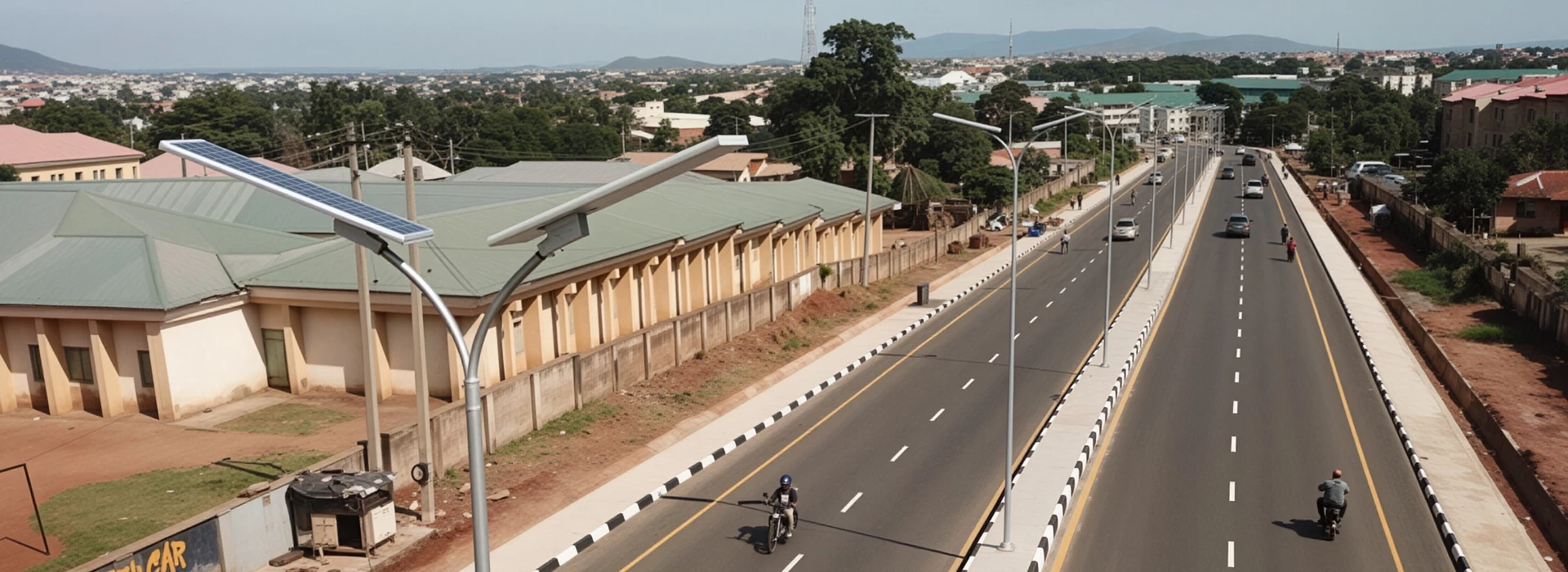
Solar Street Light Engineering Design Guide
Solar Street Light Engineering Design Guide Based on CIE M1–M5 Road Classification
Designing a reliable solar street lighting system requires more than selecting a lamp. Every project should be engineered according to road classification, lighting standards, environmental conditions, and infrastructure requirements.
This engineering guide combines international road lighting recommendations with Queneng's project experience to help municipalities, EPC contractors, distributors, and infrastructure developers select the most suitable solar street lighting configuration for highways, urban roads, industrial parks, residential streets, and rural applications.
Why Engineering Design Is the Foundation of Reliable Solar Street Lighting

-
An effective design considers lighting standards, traffic conditions, installation height, solar irradiation, battery autonomy, environmental factors, and component compatibility as a complete system. Proper engineering reduces maintenance costs, improves energy efficiency, extends system lifespan, and ensures stable illumination throughout the year.
Whether the project is a municipal road, highway, industrial park, airport, or rural village, every application requires a tailored design approach rather than a one-size-fits-all configuration.
Insufficient Road Illumination
Short Lighting Duration
High Maintenance Costs
Unnecessary Investment
Our Solar Street Light Engineering Design Process
Every successful project begins with a systematic engineering workflow. Queneng follows a structured design process to evaluate road conditions, lighting requirements, environmental factors, and system configuration before recommending the optimal solar street lighting solution.


CIE M1–M5 Solar Street Light Engineering Configuration Matrix
-
The following engineering configuration matrix summarizes Queneng's recommended solar street lighting solutions based on CIE M1–M5 road classifications. It integrates international lighting recommendations, engineering experience, installation practices, and environmental considerations into one comprehensive reference.
-
The matrix is intended to help engineers, contractors, municipalities, and project developers quickly identify suitable system configurations for different road types and infrastructure applications.
-
Please scroll the table horizontally to view more →.
| CIE Road Classification | Application Scenario | Standard Lane Quantity (Dual Direction) | Average Luminance Lₐᵥ (cd/m²) | Overall Uniformity (U₀) | Longitudinal Uniformity (U_L) | Average Illuminance Eₐᵥ(lx) | Illuminance Uniformity (U_E) | Threshold Increment (TI) | Surround Ratio (SR) | Recommended Illuminance | Recommended Pole Height | Recommended Power | Recommended Spacing | Recommended Beam Distribution | Battery Backup Days | Pole Material | Solar Panel Size | Battery Capacity | Controller Type | Wind Resistance Level | IP Rating | Installation Environment | DIALux Design Example | Recommended Project | Recommended Product |
| M1 | Expressways, airport roads, intercity highways, transportation corridors, toll stations, bridge entrances, coastal highways | Dual Carriageway Expressway (6–8 Lanes, Fully Access-Controlled) | 2 | 0.4 | 0.7 | 30 | 0.4 | 10 | 0.5 | 30 Lux | 10–12m | 120–200W | 30–40m | Type II / III Batwing | 5–7 rainy days | Hot-dip galvanized steel pole, anti-corrosion coating option | 200–240W high-efficiency monocrystalline panel | 100–120Ah LiFePO₄ lithium battery | Smart MPPT Controller with intelligent charge/discharge management | ≥38m/s (Typhoon-resistant option available) | IP65 / IP66 optional | High-speed roads, coastal areas, high traffic infrastructure projects | 12m Pole + 180W Split Solar Street Light + 36m Spacing | Lagos Expressway Project, Nigeria | 180W–200W Split Solar Street Light Series |
| M2 | Municipal roads, commercial streets, urban main roads, smart city projects | Dual Carriageway (4 Lanes with Central Median) | 1.5 | 0.4 | 0.7 | 20 | 0.4 | 10 | 0.5 | 20 Lux | 8–10m | 80W–150W | 28–35m | Type II Medium Distribution | 4–6 rainy days | Hot-dip galvanized steel pole | 150–200W monocrystalline panel | 80–100Ah LiFePO₄ lithium battery | Smart MPPT Controller | ≥36m/s | IP65 | Urban roads, commercial districts, municipal projects | 10m Pole + 150W Split Solar Street Light + 32m Spacing | Abuja Municipal Road Project, Nigeria | 120W–150W Split Solar Street Light Series |
| M3 | Secondary urban roads, township roads, residential connector roads | Two-Way Road (2–4 Lanes, No Central Median) | 1 | 0.4 | 0.5 | 15 | 0.4 | 10 | 0.5 | 15 Lux | 7–9m | 60W–120W | 25–35m | Type II Distribution | 4–5 rainy days | Hot-dip galvanized steel pole | 120–180W monocrystalline panel | 60–80Ah LiFePO₄ lithium battery | Smart MPPT Controller | ≥35m/s | IP65 | Township roads, residential areas, industrial parks | 8m Pole + 100W All-in-One Solar Street Light + 30m Spacing | Nairobi Township Road Project, Kenya | 80W–120W All-in-One Solar Street Light Series |
| M4 | Community roads, residential streets, small urban streets, public areas | Two-Way 2-Lane Road / One-Way 2-Lane Road | 0.75 | 0.4 | 0.4 | 10 | 0.3 | 15 | 0.3 | 10 Lux | 6–8m | 40W–80W | 20–30m | Type III Distribution | 3–5 rainy days | Hot-dip galvanized steel pole | 100–150W monocrystalline panel | 40–60Ah LiFePO₄ lithium battery | Smart MPPT Controller | ≥32m/s | IP65 | Residential communities, schools, parks, public facilities | 7m Pole + 60W All-in-One Solar Street Light + 25m Spacing | Community Road Lighting Project, Tanzania | 60W All-in-One Solar Street Light Series |
| M5 | Rural roads, agricultural roads, villages, off-grid projects | Two-Way Single-Lane Road / One-Way Single-Lane Road | 0.5 | 0.35 | — | 6 | 0.25 | 20 | — | 6 Lux | 5–6m | 30W–60W | 20–25m | Type III Wide Distribution | 3–4 rainy days | Hot-dip galvanized steel pole | 80–120W monocrystalline panel | 30–40Ah LiFePO₄ lithium battery | Smart MPPT Controller | ≥30m/s | IP65 | Remote areas, villages, agricultural roads, off-grid applications | 6m Pole + 40W Economic Solar Street Light + 22m Spacing | Rural Electrification Project, Uganda | 30W–60W Economic Solar Street Light Series |
How to Read the Engineering Configuration Matrix

CIE Road Classification
Lighting Performance Requirements
Recommended System Configuration
Installation Recommendations
Key Factors That Influence Solar Street Light Design
-
Although the configuration matrix provides standard engineering recommendations, every project has unique site conditions. The following factors should always be evaluated before finalizing a solar street lighting design.

Road Classification

Road Width & Pole Spacing

Local Solar Radiation

Rainy Season & Battery Backup

Wind Resistance & Pole Strength

Installation Environment
Engineering Design Examples by CIE M1–M5 Road Classification
-
The following examples demonstrate Queneng's recommended solar street lighting configurations for different CIE road classifications. Actual system design should be adjusted according to project location, solar resources, road width, lighting requirements, and environmental conditions.
| CIE Road Classification | Application Scenario | Recommended Product Type | LED Power | Pole Height | Spacing | Typical Application |
|---|---|---|---|---|---|---|
| M1 | Highway / Expressway | Split Solar Street Light | 180W | 12m | 36m | High-speed roads, expressways, airport roads, transportation corridors |
| M2 | Municipal Road | Split Solar Street Light | 150W | 10m | 32m | Urban main roads, commercial streets, municipal infrastructure projects |
| M3 | Urban Road | All-in-One Solar Street Light | 100W | 8m | 30m | Secondary urban roads, industrial parks, township roads |
| M4 | Community Road | All-in-One Solar Street Light | 60W | 7m | 25m | Residential areas, schools, parks, public facilities |
| M5 | Village Road | Economic Solar Street Light | 40W | 6m | 22m | Rural roads, villages, agricultural roads, off-grid areas |
Frequently Asked Questions About Solar Street Light Engineering Design
-
Find answers to some of the most common questions about Queneng, our factory, and our approach to solar street lighting projects.
Design Guide
How do I determine the correct CIE road classification for a solar street lighting project?
The correct CIE road classification depends on several factors, including road function, traffic speed, traffic volume, surrounding environment, and the importance of the transportation route.
Generally:
- M1 is suitable for high-speed roads such as expressways, airport roads, intercity highways, and major transportation corridors.
- M2 is commonly used for important urban roads, commercial streets, and municipal main roads.
- M3 applies to secondary urban roads, industrial parks, and township-connecting roads.
- M4 is suitable for residential streets, communities, schools, and public areas.
- M5 is typically used for rural roads, villages, agricultural roads, and low-traffic areas.
Selecting the correct road classification is the first step because it directly affects required illumination level, pole height, LED power, spacing, and overall solar system configuration.
How is solar street light pole spacing calculated?
Pole spacing is determined based on multiple engineering factors rather than a fixed distance.
The main considerations include:
- Road width
- Pole height
- LED power
- Optical lens distribution
- Beam angle
- Required lighting uniformity
- Road classification
For example:
- Higher poles usually allow wider spacing.
- Wider road areas require optimized beam distribution.
- Higher-class roads such as M1 and M2 require stricter uniformity requirements.
In practical projects, Queneng engineers evaluate the complete lighting layout and may use professional lighting simulation tools such as DIALux to verify the recommended pole spacing.
How many rainy backup days should be considered for solar street lights?
The required battery backup days depend on local climate conditions, solar radiation levels, and project reliability requirements.
Typical recommendations:
| Application Environment | Recommended Backup Days |
|---|---|
| High solar radiation areas | 3–4 rainy days |
| Tropical regions with seasonal rainfall | 4–6 rainy days |
| Long rainy season areas | 5–7 rainy days |
| Critical infrastructure projects | 7+ days |
African infrastructure projects often require additional consideration due to seasonal rainfall, cloudy periods, and remote maintenance conditions.
Queneng adjusts battery capacity and solar panel sizing according to project location and weather conditions.
Can Queneng provide DIALux simulation for solar street lighting projects?
Yes.
For municipal roads, highways, and large infrastructure projects, Queneng can provide lighting simulation support to help verify system performance.
DIALux simulation can evaluate:
- Average illuminance
- Average luminance
- Lighting uniformity
- Light distribution
- Pole spacing
- Installation height
- Road coverage
This helps ensure the proposed solar street lighting system meets project requirements before installation.
Can the solar street light configuration be customized?
Yes.
The recommended configurations in the M1–M5 engineering matrix are reference solutions. Each project can be customized according to actual requirements.
Customization factors include:
- Project location
- Road classification
- Installation height
- Lighting duration
- Solar radiation
- Rainy season conditions
- Budget requirements
- Local installation standards
Queneng provides customized solutions, including:
- LED power selection
- Solar panel sizing
- Battery capacity adjustment
- Controller configuration
- Pole design
- Lighting layout optimization
What information is required before solar street light system design?
To develop an accurate engineering design, the following project information is recommended:
Basic Project Information
- Project location
- Country and city
- Application scenario
- Road type
Road Information
- Road width
- Number of lanes
- Median arrangement
- Required pole height
- Pole spacing requirements
Environmental Conditions
- Solar radiation data
- Rainy season information
- Temperature range
- Wind speed
- Coastal or inland environment
Project Requirements
- Lighting standard
- Operating hours per night
- Backup days requirement
- Quantity required
Based on this information, Queneng can recommend a complete solar street lighting configuration.
Which solar street lighting system is suitable for African infrastructure projects?
The suitable system depends on the application scenario and environmental conditions.
Typical recommendations:
| Application | Recommended System |
|---|---|
| Highways and transportation corridors | High-power split solar street lights |
| Municipal roads | Medium/high-power split systems |
| Urban streets | All-in-one solar street lights |
| Rural roads | Economic solar street light systems |
| Remote off-grid areas | Low-maintenance standalone solar lighting |
African projects often require consideration of:
- Long sunlight exposure
- Seasonal rainfall
- Dust and high temperature
- Limited grid availability
- Remote maintenance conditions
Therefore, reliable components, sufficient battery autonomy, and proper system sizing are essential.
How do climate conditions affect solar street light component selection?
Climate conditions directly influence system design and component selection.
High Temperature Areas
Require:
- Temperature-resistant lithium batteries
- Efficient heat dissipation design
- Reliable electronic components
Coastal Areas
Require:
- Anti-corrosion poles
- Salt spray resistance
- Higher protection levels
Dusty or Desert Areas
Require:
- Better sealing protection
- Dust-resistant housing design
- Easy maintenance structure
Areas with Long Rainy Seasons
Require:
- Larger solar panel capacity
- Higher battery backup days
- Optimized energy management
A professional solar street lighting design always considers local environmental conditions before selecting components.
Need an Engineering-Based Solar Street Lighting Solution?
Every infrastructure project has unique technical requirements. Share your project location, road classification, installation height, and lighting objectives, and Queneng's engineering team will recommend a complete solar street lighting solution based on international standards and local environmental conditions.
The messenger of light & power conversion.
© 2026 Queneng Light
 Jason Qiu
Queneng
Queneng
Queneng
Queneng