
Smart MPPT Controller
Smart MPPT Solar Lighting Controller Technology for High-Performance Solar Street Lights
At Queneng, we believe that a solar street light is only as reliable as the technology controlling its energy.
While solar panels collect sunlight, batteries store energy, and LED chips generate illumination, it is the controller that determines how efficiently these components work together. The controller acts as the decision-making center of the entire solar lighting system, continuously managing charging, storage, power distribution, and lighting output.
As a professional solar street light manufacturer, Queneng has developed its own smart MPPT solar lighting controller technology to serve as the energy management core of our integrated and split solar street lighting systems.
Unlike standard third-party controllers commonly used in the market, Queneng's intelligent control architecture has been optimized specifically for outdoor lighting infrastructure projects in Africa and other developing regions where environmental conditions, grid limitations, and maintenance accessibility create unique operational challenges.
Through intelligent MPPT charging, adaptive battery management, constant-current LED driving, and smart lighting control strategies, the system maximizes solar energy utilization while ensuring stable night-time illumination and long-term project reliability.
Whether deployed on highways in Nigeria, municipal roads in Kenya, industrial parks in Zambia, or rural electrification projects in Tanzania, the Queneng controller continuously adapts to changing environmental conditions to deliver dependable lighting performance year after year.
The Technology Behind Long-Term Solar Lighting Reliability
Many solar street lighting failures are not caused by solar panels, batteries, or LEDs.
Instead, they are often the result of poor energy management.
When charging efficiency is low, batteries cannot store sufficient energy. When discharge control is inaccurate, battery lifespan decreases rapidly. When LED driving is unstable, lighting quality deteriorates and maintenance costs increase.
The Queneng Smart MPPT Controller continuously manages


The result is our lighting system capable of delivering consistent illumination while maximizing the lifespan of critical system components.
Why MPPT Technology Matters
The Difference Between Collecting Solar Energy and Utilizing It Efficiently
Not all solar controllers are created equal.
Many conventional controllers use PWM (Pulse Width Modulation) technology, which limits the amount of usable energy that can be harvested from solar panels.
While PWM technology may reduce initial costs, it often sacrifices charging efficiency, battery performance, and overall system stability.
Queneng adopts advanced MPPT (Maximum Power Point Tracking) technology to continuously identify the optimal operating point of the solar panel and maximize charging performance throughout the day.
By dynamically adjusting charging parameters according to real-time environmental conditions, the controller captures more usable energy and improves overall system efficiency.
Key Benefits of MPPT Technology


For municipal infrastructure projects and commercial lighting systems, these advantages directly contribute to lower maintenance costs and improved return on investment.

Designed for African Solar Street Lighting Projects
Engineered for Real-World Conditions
Many solar lighting products are designed and tested under laboratory conditions that differ significantly from actual deployment environments.
Across Africa, solar street lighting systems often face challenging operating conditions.
Key Benefits of MPPT Technology


These conditions place significant stress on batteries, solar panels, and control systems.
Queneng has spent years supplying solar street lighting systems to projects across the board.


Our Smart MPPT Controller Employs an Adaptive Charging Algorithm Designed to Maximize Energy Efficiency in a Variety of Environments.
This experience has allowed our engineering team to continuously refine controller performance based on real-world project requirements rather than theoretical assumptions.

How Queneng Smart MPPT Technology Works
Intelligent Energy Management from Sunrise to Sunrise
The Queneng controller acts as the central intelligence hub of the entire solar lighting system.
Every day, the controller continuously coordinates energy flow between power generation, energy storage, and lighting output.
Smart MPPT Controller System Workflow
Smart MPPT Controller System Workflow


During daylight hours, the controller continuously monitors solar panel output and identifies the maximum power point to maximize charging efficiency.
As energy is stored within the battery system, intelligent charging algorithms optimize charging speed while protecting battery health.
At sunset, the controller automatically activates the lighting system and regulates energy consumption according to programmed lighting strategies.
Throughout the night, adaptive power management continuously balances brightness levels, battery reserve capacity, and operating duration to maintain reliable illumination until sunrise.

Core Technologies Inside the Queneng Smart Controller

Why This Technology Matters for Infrastructure Projects
For contractors, distributors, municipalities, and project developers, reliable lighting performance is not simply a technical requirement—it is a financial requirement.
Every maintenance visit, battery replacement, or lighting failure increases operating costs and reduces project value.
By integrating intelligent energy management, adaptive charging logic, battery protection systems, and efficient LED driving technologies into a unified architecture, Queneng helps customers reduce maintenance requirements, improve lighting consistency, and achieve better long-term project performance.
MPPT vs PWM Technology Comparison


Why Controller Technology Directly Impacts Project Performance
Many solar street lighting projects focus heavily on solar panel wattage, battery capacity, or LED brightness while overlooking the most critical component responsible for energy management—the controller.
The charging technology used inside the controller directly affects how much solar energy is converted into usable electricity and how efficiently that energy is stored and utilized.
For large-scale road lighting projects, even small improvements in charging efficiency can significantly increase lighting runtime, reduce battery stress, and improve long-term system stability.
MPPT vs PWM Comparison
| Feature | Queneng MPPT Technology | Traditional PWM Technology |
| Solar Energy Harvesting | Dynamic Tracking | Fixed Charging |
| Charging Efficiency | Up to 99% | 70%–85% |
| Battery Charging Speed | Faster | Slower |
| Low-Light Performance | Excellent | Limited |
| Rainy Season Operation | Optimized | Reduced Performance |
| Battery Lifespan | Extended | Shorter |
| Lighting Runtime | Longer | Shorter |
| Energy Utilization | Higher | Lower |
| System Stability | Excellent | Moderate |
| Long-Term Project ROI | Higher | Lower |
Why Queneng Chooses MPPT
For projects in Nigeria, Kenya, Uganda, Tanzania, Zambia, and other African markets, maximizing every available watt of solar energy is essential.
MPPT technology allows our lighting systems to continue operating efficiently even when sunlight conditions are less than ideal, helping contractors and municipalities achieve more reliable lighting performance throughout the year.
Smart Rainy Days Energy Management Strategy
Built for Consecutive Cloudy and Rainy Days
One of the most common concerns raised by project owners is "Will the lights still work after several rainy days?"
This question is especially important in tropical and subtropical regions where prolonged cloudy weather can reduce solar charging efficiency.
Rather than relying solely on battery capacity, Queneng approaches the problem through intelligent energy management.
How the System Responds
Based on these factors, the system automatically adjusts energy allocation to maximize lighting duration.
Intelligent Response Strategy

MPPT Controllers Comprehensive Technical Specifications
Electrical Parameters
| Item | Specification |
|---|---|
| MPPT Tracking Efficiency | ≥99% |
| Charging Conversion Efficiency | ≥98% |
| System Voltage | 12V / 24V |
| Battery Type | LiFePO4 |
| Maximum PV Input Voltage | 150 VDC |
| Maximum Charging Current | 20A / 30A / 40A |
| Output Power Range | 20W–300W |
| Constant Current Accuracy | ±1% |
| Dimming Levels | 5-Level Intelligent Dimming |
| Dimming Method | Time-Based Programming |
| Motion Sensor Integration | Optional |
| Remote Monitoring | Optional |
| Communication Interface | RS485 |
| IoT Compatibility | Optional |
| Output Ripple | <3% |
| Standby Consumption | <0.5W |
| Battery Temperature Compensation | Yes |
| Adaptive Charging Control | Yes |
| Intelligent Power Allocation | Yes |
| Rainy Day Management | Yes |
Environmental Parameters
| Item | Specification |
|---|---|
| Waterproof Rating | IP67 |
| Operating Temperature | -35°C ~ +65°C |
| Storage Temperature | -40°C ~ +80°C |
| Relative Humidity | 0%–95% RH |
| Dust Protection | Full Protection |
| Corrosion Resistance | Outdoor Grade |
| UV Resistance | ✓ |
| Thermal Protection | Integrated |
Safety Protection Functions
| Protection Function | Status |
|---|---|
| Overcharge Protection | ✓ |
| Over-discharge Protection | ✓ |
| Reverse Polarity Protection | ✓ |
| Short Circuit Protection | ✓ |
| Overcurrent Protection | ✓ |
| Overtemperature Protection | ✓ |
| Battery Balancing Protection | ✓ |
| Surge Protection | ✓ |
| Load Protection | ✓ |
Controller Manufacturing Process
From Engineering Design to Final Delivery
The reliability of a controller is determined long before installation.
Every Queneng Smart MPPT Controller undergoes a structured manufacturing and testing process to ensure stable field performance.


Why Contractors, Distributors & Municipalities Choose Queneng Engineering & R&D Capabilities

Technology Developed by a Solar Street Light Manufacturer
Unlike many suppliers that purchase generic third-party controllers, Queneng develops and integrates its own control technology as part of a complete solar lighting system.
Queneng is not simply a reseller of assembled products


Designed for Diverse Solar Street Lighting Projects Applications & Solutions
Queneng Smart MPPT Solar Lighting Controller Technology is engineered to support a wide range of outdoor lighting applications where reliability, energy efficiency, and long-term performance are critical.
Whether powering a single rural road or an extensive municipal lighting network, the controller continuously optimizes energy utilization to maximize system performance.


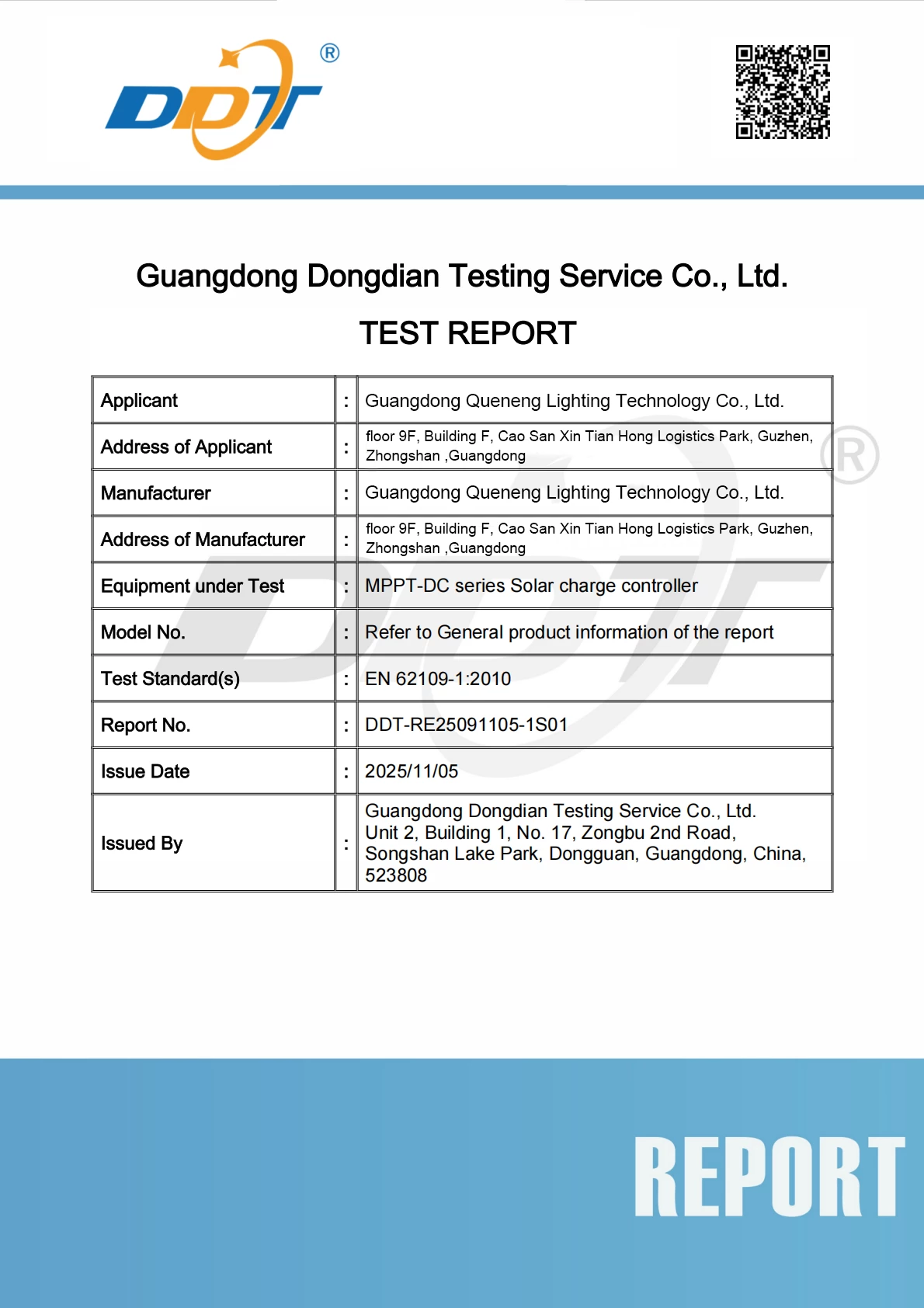
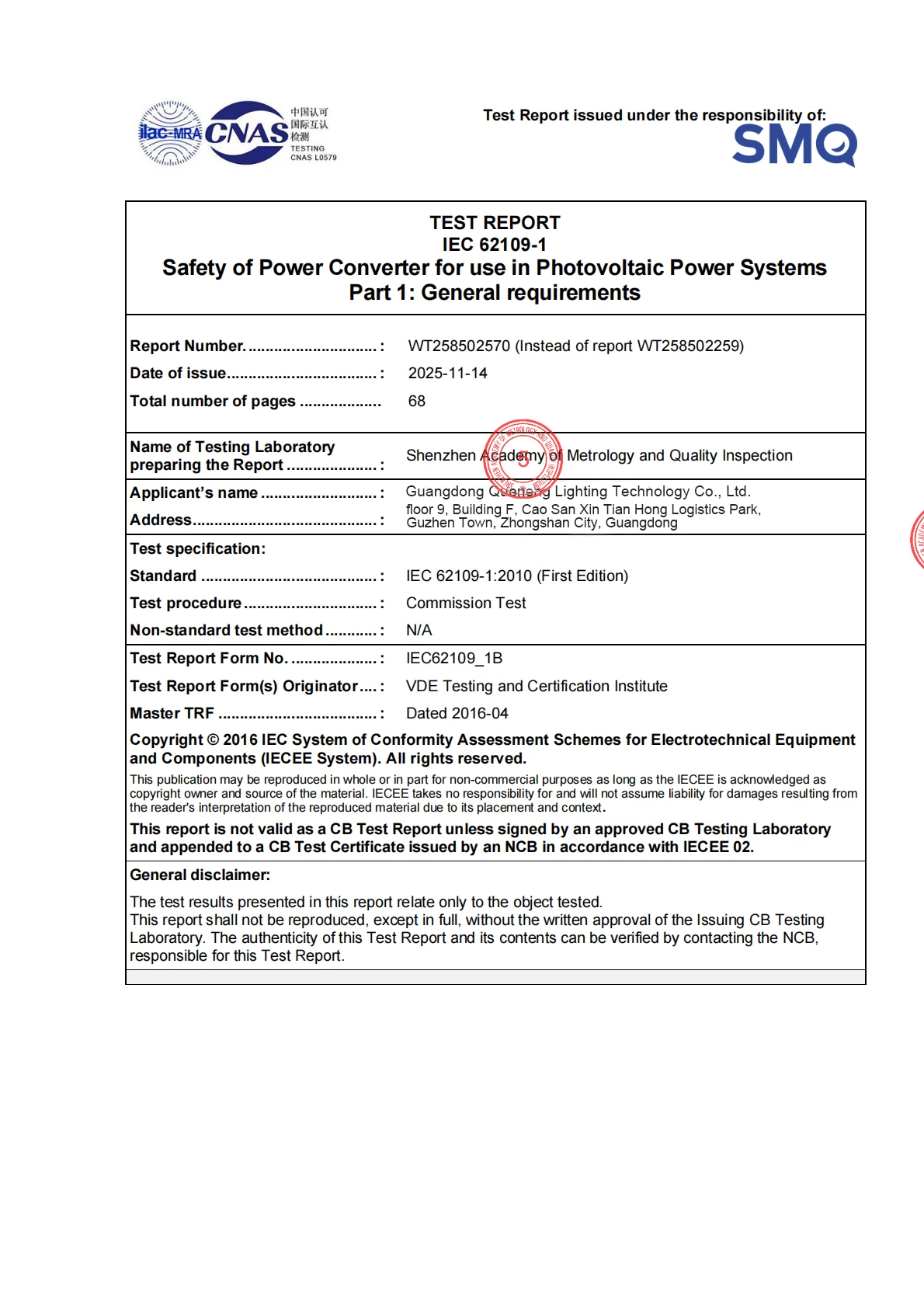
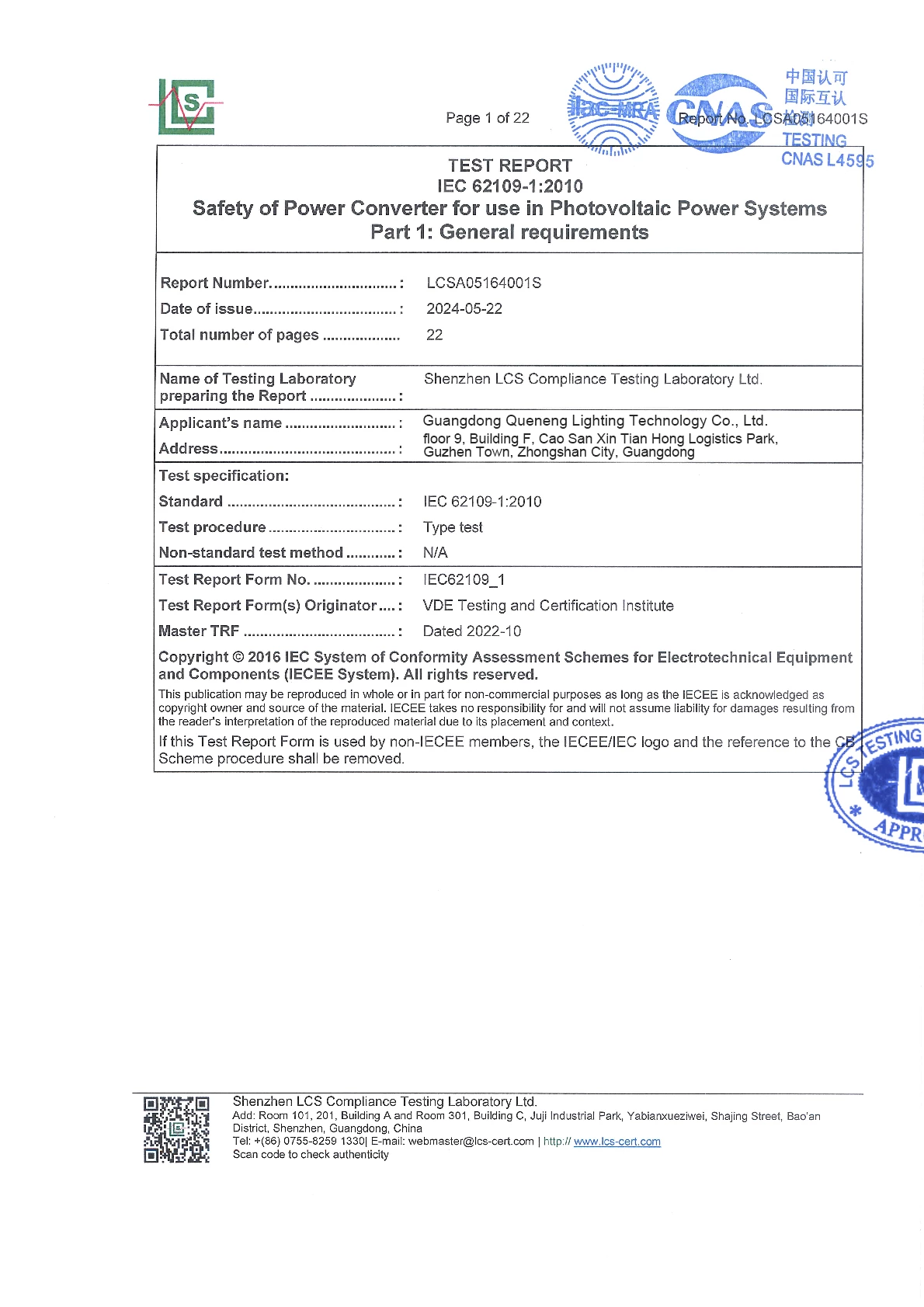
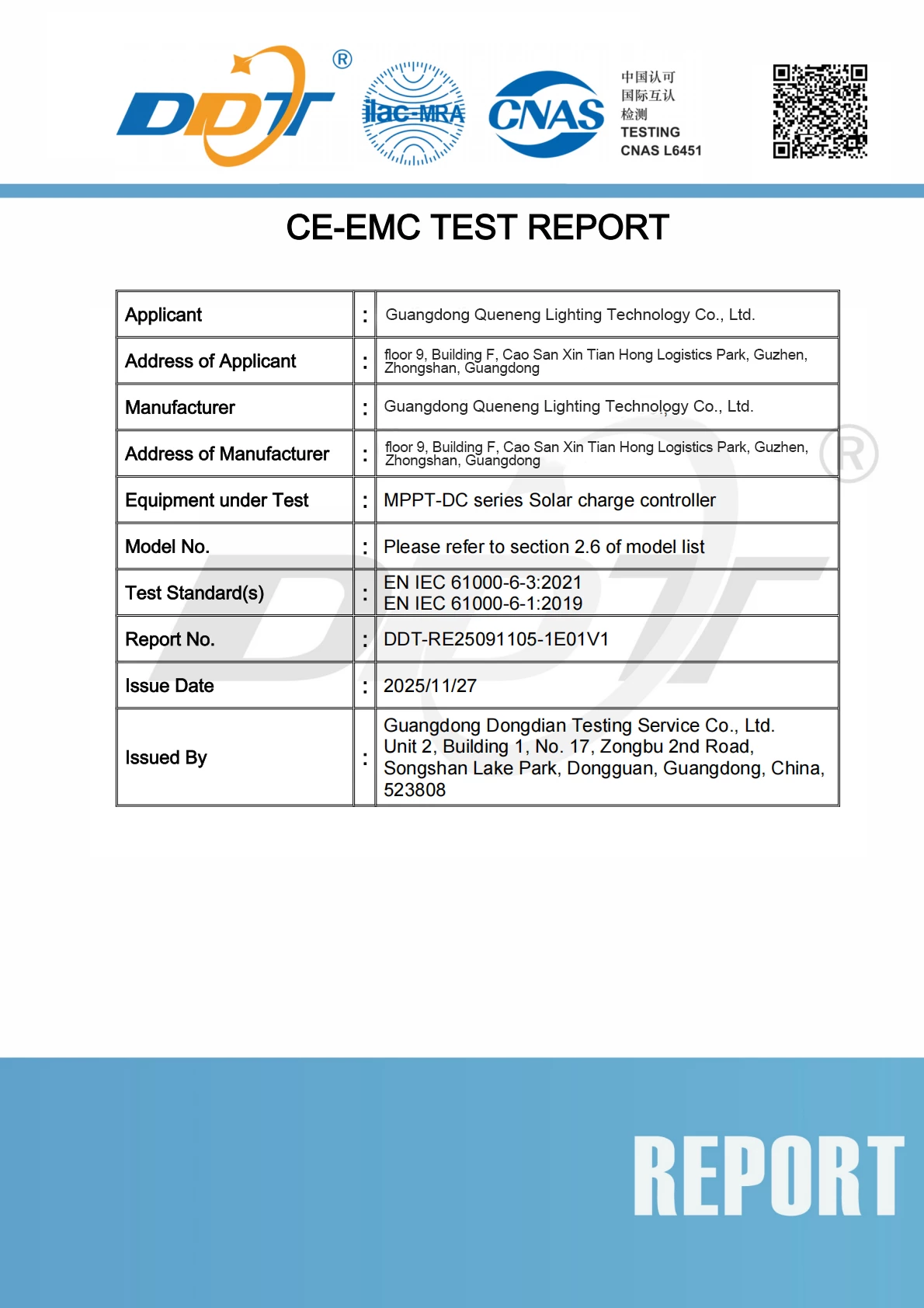
Certified MPPT Technology for Professional Solar Lighting Systems
Queneng Smart MPPT Controller Technology is supported by professional testing and certification processes to ensure stable performance, electrical safety, and long-term reliability under demanding outdoor environments.



Any questions?
MPPT Controller Technology
What is MPPT technology?
MPPT (Maximum Power Point Tracking) is an advanced charging technology that continuously identifies the optimal operating point of a solar panel to maximize energy harvesting efficiency.
Why is MPPT important for solar street lights?
MPPT technology helps improve charging efficiency, extend battery life, increase lighting runtime, and optimize overall system performance.
How efficient is the Queneng MPPT controller?
The controller achieves MPPT tracking efficiency of up to 99% under optimal operating conditions.
Can the controller work with LiFePO4 batteries?
Yes. Queneng controllers are specifically designed to support LiFePO₄ battery systems commonly used in modern solar street lights.
Is the controller suitable for African climates?
Yes. The controller has been engineered to operate reliably under high temperatures, heavy rainfall, and dusty environments commonly found throughout Africa.
How many rainy days can the system support?
Performance depends on system configuration, battery capacity, solar panel size, and lighting requirements. Intelligent energy management helps maximize operation during extended cloudy periods.
Does the controller support intelligent dimming?
Yes. Multiple dimming strategies can be programmed according to project requirements.
Can motion sensors be integrated?
Yes. Optional motion sensor functionality is available.
Is remote monitoring available?
Optional communication and monitoring functions can be integrated according to project requirements.
What protection functions are included?
The controller includes:
- Overcharge protection
- Over-discharge protection
- Short-circuit protection
- Reverse polarity protection
- Overcurrent protection
- Thermal protection
Can the controller be customized?
Yes. OEM and ODM customization services are available.
What is the waterproof rating?
The controller is designed for outdoor environments and supports IP67 protection.
How does the controller improve battery lifespan?
Through intelligent charging algorithms, temperature compensation, and multi-layer battery protection functions.
Lasted Insights From Our Experts
Explore engineering guides, installation recommendations, project planning resources, battery configuration advice, and solar roadway lighting best practices for infrastructure projects across Africa.

Choosing the right solar street light system is essential for achieving reliable outdoor lighting performance, long battery lifespan, and stable nighttime illumination.
Whether the project is for municipal roads, highways, industrial parks, villages, commercial spaces, or public infrastructure, selecting the proper solar street lighting configuration directly affects energy efficiency, installation costs, maintenance requirements, and long-term operational stability.
This guide explains the key factors that should be considered when choosing a solar street lighting system for different outdoor applications and environmental conditions.

For many years, solar street lighting was often viewed as a niche solution mainly used in remote villages or small off-grid applications.
That perception has changed rapidly.
Today, solar street lighting systems are being deployed across municipal roads, highways, industrial parks, residential communities, mining areas, and large-scale infrastructure projects worldwide.
The reason is no longer only environmental sustainability.
It is economics.
As electricity prices continue rising and infrastructure construction becomes more expensive, governments, contractors, and developers are paying closer attention to long-term operational costs instead of simply comparing upfront equipment pricing.
And this is where solar street lighting starts becoming financially attractive.
At first glance, many buyers still assume solar street lights are expensive.
After all, a complete system includes:
- • solar panels
- • lithium batteries
- • LED fixtures
- • intelligent controllers
- • structural mounting systems
Compared to a conventional street lamp fixture alone, the initial quotation may appear significantly higher.
But experienced infrastructure planners rarely evaluate a project based only on fixture cost.
Because in real-world roadway projects, the lighting fixture is often only a small part of the total investment.

The solar charge controller is one of the most critical components in a solar street lighting system. It directly affects charging efficiency, battery lifespan, and system reliability.
Two commonly used technologies are MPPT (Maximum Power Point Tracking) and PWM (Pulse Width Modulation) controllers.
This article explains their differences and helps you choose the right solution for solar street lighting projects.
Looking for Reliable Solar Street Lighting Solutions?
Whether you are a distributor, contractor, engineering company, or government project developer, Queneng can help you deliver dependable solar lighting projects. Contact Queneng today to discuss your next solar lighting project.
The messenger of light & power conversion.
© 2026 Queneng Light
 Jason Qiu
Queneng
Queneng
Queneng
Queneng