

An upfront price only tells half the story. Here's the full cost breakdown — installation, electricity bills, maintenance, and reliability — so you can see which option actually costs less over your project's lifetime.

Solar Street Light vs Grid Street Light: Which Costs Less Over 10 Years?
When a government agency, municipality, or EPC contractor compares solar street lights against grid-connected street lights, the conversation almost always starts and stops at upfront price. That's a mistake. Grid-connected lighting looks cheaper on day one and gets progressively more expensive every year after—through electricity bills, cable maintenance, and infrastructure repair. Solar lighting looks more expensive on day one and gets cheaper every year after. The real comparison is the total cost of ownership over the system's working life, not the number on the first invoice.
This guide breaks the comparison into every cost category that actually matters, so you can build an honest total cost of ownership picture for your specific project rather than relying on a supplier's simplified pitch either way.
In this guide: why upfront price is misleading on its own → upfront investment compared → installation cost compared → the ongoing electricity bill grid lighting carries → maintenance and infrastructure cost over time → reliability and outage exposure → environmental and regulatory factors → a worked 10-year cost example → when grid still makes sense → frequently asked questions.
Why Upfront Price Alone Is the Wrong Comparison
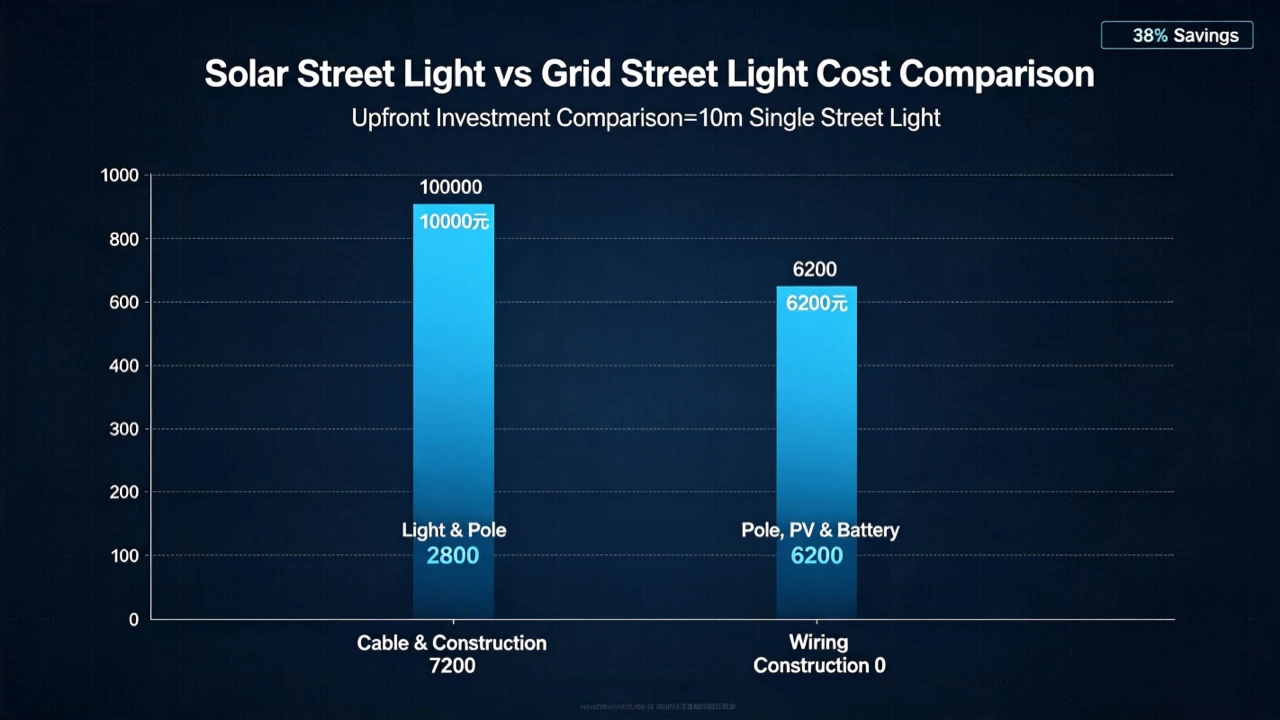
A grid-connected street light system needs a pole, a fixture, and a connection to the electrical grid, which is often already cheaper to install if grid infrastructure already runs along the road. A solar street light needs a pole, a fixture, a solar panel, a battery, and a charge controller—all included in a single upfront unit cost, with no ongoing connection required.
Comparing only these two numbers side by side makes grid lighting look like the obvious choice in many cases. But a street lighting system isn't a one-time purchase—it's a piece of infrastructure that operates for 10, 15, or more years. Every cost that recurs annually over that period needs to be added into the comparison, not just the cost of getting the lights turned on for the first time.
Upfront Investment: What's Actually Being Compared
Grid-connected street light upfront costs typically include:
- Pole and fixture
- Cabling from the nearest grid connection point
- Trenching or overhead line installation to bring power to each pole
- Transformer or substation capacity upgrades, if the existing grid infrastructure can't support the additional load
- Utility connection fees
Solar street light upfront costs typically include:
- Pole and fixture
- Solar panel
- Battery (lithium or lead-acid)
- Charge controller
- No grid connection or trenching required
In areas where grid infrastructure already exists close to the installation site, grid lighting's upfront cost can indeed be lower per pole. But in rural areas, along new roads, or anywhere the grid needs to be extended to reach the site, trenching and cabling costs can rise sharply—and in many of these cases, solar street lights end up cheaper even before accounting for any ongoing costs at all. This is one of the most common reasons solar lighting has become the default choice for rural electrification and highway projects across much of Africa.
Installation Cost and Timeline
Grid-connected installation typically takes longer per pole because it requires trenching or overhead line work, connection to the local utility, and often a formal utility approval process before the connection is activated. Delays here are common — utility approval timelines are frequently outside the contractor's control.
Solar street light installation, by contrast, doesn't depend on utility involvement at all. Each pole is a self-contained unit that can be installed and made operational the same day, without waiting for a grid connection to be approved or energized. For projects with a fixed deadline — an election, an infrastructure launch event, or a rainy-season cutoff — this independence from utility approval timelines is often a decisive practical advantage on its own, regardless of the cost comparison.
The Ongoing Electricity Bill Grid Lighting Carries
This is the cost category that upfront-price comparisons leave out entirely, and it's usually the single largest cost over a system's lifetime. A grid-connected street light draws electricity every night for its entire operating life, and that electricity has to be paid for — typically by the municipality or government agency operating the lighting network, out of a recurring public budget.
Multiply a single light's nightly electricity draw by the number of poles in a project and the number of operating hours per year, and the electricity bill for a large street lighting network becomes a substantial, permanent line item in the operating agency's budget — one that grows with electricity price inflation over time. Solar street lights carry no electricity bill at all because the sun is the fuel source, and it's free for the life of the system.
Maintenance and Infrastructure Cost Over Time
Grid-connected street lighting infrastructure requires ongoing maintenance beyond the light fixture itself: underground cables degrade and require repair, overhead lines are vulnerable to storm damage and vehicle collisions, and transformer or substation capacity needs periodic upgrading as demand grows. Each of these repairs typically requires specialized utility contractors, not just a lighting maintenance crew.
Solar street lights have their own maintenance needs—battery replacement over the system's life being the main one—but they don't carry the cable and grid-infrastructure maintenance burden at all, since there's no cable network to maintain in the first place. This is a meaningful difference at scale: a 500-pole grid-connected network has 500 poles' worth of cable that can fail, while a 500-pole solar network has zero shared points of failure between poles, since each pole operates independently.
Reliability and Outage Exposure
Grid-connected street lights go dark whenever the grid goes down—a common occurrence in many parts of Africa where grid reliability is inconsistent, particularly outside major urban centers. When the grid fails, the entire connected lighting network fails with it, all at once, regardless of how well-maintained the individual fixtures are.
Solar street lights are independent of grid reliability entirely. A grid outage affecting an entire region has zero impact on a solar-powered lighting network, because each pole generates and stores its own power. For safety and security lighting specifically—where an outage means genuinely dark, unsafe roads—this independence is often the single strongest argument for solar lighting, separate from any cost calculation.
Environmental and Regulatory Factors
Many government infrastructure projects now carry sustainability or emissions-reduction targets tied to funding agreements, climate commitments, or donor requirements—particularly for internationally financed infrastructure projects across Africa. The World Bank's distributed renewable energy initiatives illustrate how solar-based power access is increasingly prioritized across the region. Solar street lighting generates zero operational emissions, which can matter directly for projects that need to meet these targets, separate from the pure cost comparison. Grid-connected lighting's emissions profile depends entirely on how the electricity on that grid is generated, which in many African markets still includes a meaningful share of fossil fuel generation.

A Worked 10-Year Cost Example
To make the comparison concrete, consider a simplified 100-pole street lighting project over a 10-year period:
Grid-connected system (illustrative):
- Upfront cost: pole, fixture, cabling, and grid connection for 100 poles
- Annual electricity bill: recurring cost every year for 10 years, growing with electricity price inflation
- Cable and infrastructure maintenance: periodic repair costs over the 10-year period
- Outage-related costs: not always monetary, but real in terms of safety incidents and reduced road usage during grid failures
Solar system (illustrative):
- Upfront cost: pole, fixture, panel, battery, and controller for 100 poles — typically higher than the grid system's upfront cost
- Annual electricity bill: zero
- Maintenance: periodic battery replacement, generally lower cost than cable and grid infrastructure repair
- Outage-related costs: none, since the system operates independently of grid reliability
In most real-world comparisons across African markets, the grid system's cumulative electricity bill alone—added up over 10 years—closes most or all of the upfront cost gap with solar, often before infrastructure maintenance and outage costs are even factored in. The exact break-even point depends heavily on local electricity tariffs, grid extension distance, and financing terms, which is why a project-specific total cost of ownership calculation is far more useful than a generic industry average.
When Grid Lighting Still Makes Sense
Solar isn't the right answer for every project, and it's worth being direct about when grid-connected lighting remains the more sensible choice:
- Dense urban areas with existing, reliable grid infrastructure already in place along the road — where no new trenching or connection work is needed, and grid reliability is genuinely strong
- Areas with very low electricity tariffs and highly reliable grid supply, where the ongoing electricity cost advantage of solar is smaller
- Projects where centralized, networked lighting control (dimming schedules, centralized monitoring across a connected grid) is a specific operational requirement that's easier to implement on a connected network
For most rural roads, highway corridors, areas with unreliable grid supply, or projects where grid extension would require significant new infrastructure, solar has a clear total-cost-of-ownership advantage over the system's working life.
Frequently Asked Questions
Is solar street lighting actually cheaper than grid lighting?
Not always upfront, but often over the system's full lifetime once electricity bills, grid maintenance, and outage risk are factored in—particularly in areas where grid extension is costly or grid reliability is inconsistent.
How long does it take for solar street lights to pay for themselves compared to grid lighting?
The break-even point depends on local electricity tariffs, grid extension distance, and financing terms, but many projects in areas with limited existing grid infrastructure see solar reach cost parity within the first several years of operation, with clear savings afterward.
Do solar street lights work reliably during cloudy or rainy seasons?
Yes, provided the battery and panel are sized with sufficient autonomy—commonly 3-5 days—to cover consecutive low-sun periods. Proper sizing for local climate conditions is essential to reliable performance.
What's the biggest ongoing cost difference between solar and grid street lighting?
The recurring electricity bill is usually the largest ongoing cost for grid-connected lighting, and it's a cost solar lighting doesn't carry at all, since the sun is a free, ongoing energy source.
Is grid-connected lighting ever the better choice?
Yes—in dense urban areas with existing, reliable grid infrastructure and low electricity tariffs already in place, grid lighting can remain the more practical and economical choice, particularly where no new grid extension work is needed.
Does solar lighting require less maintenance than grid lighting?
Solar systems avoid grid infrastructure maintenance (cable repair, transformer upgrades) entirely, though they do require periodic battery replacement. Over a large multi-pole network, this generally results in lower total maintenance cost and complexity than a grid-connected system.
Final Thought
The honest comparison isn't "solar vs. grid" as a blanket statement—it's a project-specific total cost of ownership calculation that accounts for grid extension distance, local electricity tariffs, grid reliability, and the maintenance profile of each option over the system's real operating life. For most rural, highway, and unreliable-grid projects across Africa, that calculation increasingly favors solar. For dense urban areas with existing, reliable, low-cost grid infrastructure, it may not.
Want a project-specific cost comparison for your road network? Contact our team for a free estimate based on your pole count, road type, and current electricity costs, or explore our full product range to see current solar street light specifications and pricing.
Get a Configuration Quote
Please let us know your specific application scenario and product requirements—we will send you a detailed product specifications list and a reference quote within 24 hours.
Products
mentioned in this Blog
Blog
Cost Analysis
More Blogs

How to Choose the Right Solar Street Light System
Choosing the right solar street light system is essential for achieving reliable outdoor lighting performance, long battery lifespan, and stable nighttime illumination.
Whether the project is for municipal roads, highways, industrial parks, villages, commercial spaces, or public infrastructure, selecting the proper solar street lighting configuration directly affects energy efficiency, installation costs, maintenance requirements, and long-term operational stability.
This guide explains the key factors that should be considered when choosing a solar street lighting system for different outdoor applications and environmental conditions.

Solar Street Light Cost Analysis and ROI Guide
For many years, solar street lighting was often viewed as a niche solution mainly used in remote villages or small off-grid applications.
That perception has changed rapidly.
Today, solar street lighting systems are being deployed across municipal roads, highways, industrial parks, residential communities, mining areas, and large-scale infrastructure projects worldwide.
The reason is no longer only environmental sustainability.
It is economics.
As electricity prices continue rising and infrastructure construction becomes more expensive, governments, contractors, and developers are paying closer attention to long-term operational costs instead of simply comparing upfront equipment pricing.
And this is where solar street lighting starts becoming financially attractive.
At first glance, many buyers still assume solar street lights are expensive.
After all, a complete system includes:
- • solar panels
- • lithium batteries
- • LED fixtures
- • intelligent controllers
- • structural mounting systems
Compared to a conventional street lamp fixture alone, the initial quotation may appear significantly higher.
But experienced infrastructure planners rarely evaluate a project based only on fixture cost.
Because in real-world roadway projects, the lighting fixture is often only a small part of the total investment.

MPPT vs PWM Controllers for Solar Street Lighting Systems
The solar charge controller is one of the most critical components in a solar street lighting system. It directly affects charging efficiency, battery lifespan, and system reliability.
Two commonly used technologies are MPPT (Maximum Power Point Tracking) and PWM (Pulse Width Modulation) controllers.
This article explains their differences and helps you choose the right solution for solar street lighting projects.
Explore More Professional Solar Project Insights
We have more in-depth industry reports, large-scale project cases, energy-saving transformation schemes and wholesale cooperation policies.
Contact us to unlock exclusive B2B cooperation value.
The messenger of light & power conversion.
© 2026 Queneng Light
 Jason Qiu
Queneng
Queneng
Queneng
Queneng