
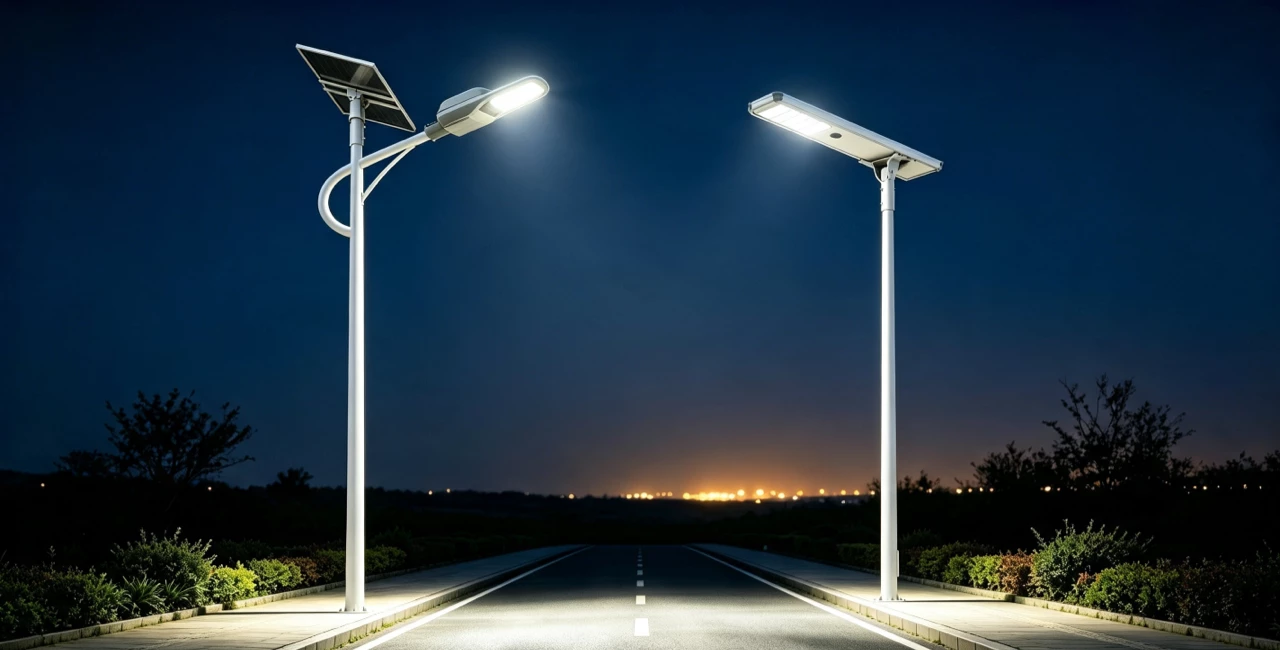

All-in-One and Split solar street lights solve the same basic problem — powering a light with solar energy instead of grid electricity — but they solve it in genuinely different ways, and the right choice depends heavily on your project's scale, timeline, and long-term maintenance plan. All-in-One integrates everything into a single pole-head unit and installs faster, while Split separates the battery for easier ground-level servicing but takes longer to deploy. This guide compares both designs across installation speed, maintenance access, performance in different climates, and total cost of ownership over a multi-year project, with a practical scenario and decision checklist to help government buyers, EPC contractors, and distributors choose confidently based on their specific pole count, deadline, and maintenance capacity.
- What "All-in-One" Actually Means
- What "Split" Design Actually Means
- Installation Speed: All-in-One Wins
- Maintenance Access: Split Wins
- Performance and Lifespan Considerations
- Cost Comparison
- A Practical Scenario
- Which Design Fits Which Project Type
- What to Ask a Supplier, Regardless of Design
- A Decision Checklist
- Frequently Asked Questions
- Final Thought

If you've been sourcing solar street lights for more than a week, you've run into this question: All-in-One or Split? Both designs solve the same basic problem—powering a street light with solar energy instead of grid electricity—but they solve it in different ways, and that difference matters more the larger your project gets. This guide breaks down exactly how the two designs differ, where each one makes sense, and what to check before you commit to thousands of units.
What "All-in-One" Actually Means
An All-in-One solar street light integrates the solar panel, battery, charge controller, and LED light source into a single compact unit mounted directly on top of the pole. There's no separate battery box, no additional wiring between components, and no ground-level or mid-pole enclosure. Everything the light needs to function is contained in one housing at the pole head.
This design became popular because it dramatically simplifies installation—a crew can mount the light head, secure it to the pole, and move to the next site without running cables between multiple components.
What "Split" Design Actually Means
A split solar street light separates the battery from the light head. The LED and light head still sit at the top of the pole, but the battery is mounted separately — typically lower on the pole, at ground level in a lockable enclosure, or buried underground in some installations. The solar panel is usually still mounted near the top of the pole, connected to the battery and light head by cabling that runs down the pole.
This separation exists for a specific reason: it makes the battery—the component most likely to need replacement over the system's lifetime—accessible without needing a lift truck or a technician to climb the pole.
Installation Speed: All-in-One Wins
If your priority is getting a large number of poles installed quickly, All-in-One has a clear edge. Because everything is integrated into a single unit, a crew mounts one component per pole instead of three or four, with no additional cable runs down the pole itself. For projects on a tight deadline — a government inauguration date, an election-linked infrastructure push, or a rainy-season cutoff — this speed advantage can be decisive on its own.
Split systems take longer per pole because the battery enclosure needs to be separately mounted or buried, wired to both the panel and the light head, and secured against tampering or theft at ground level.
Maintenance Access: Split Wins
This is where the calculation flips. Batteries are the component most likely to need attention over a project's lifetime—whether that's periodic inspection, eventual replacement, or troubleshooting a fault. On an all-in-one system, reaching the battery means reaching the pole head, which typically requires a bucket truck or specialized lift equipment.
On a split system, the battery sits within reach of a technician on the ground (or in an underground vault with a lockable lid), so replacement or inspection doesn't require special equipment at all. For a project with hundreds or thousands of poles spread across a wide geographic area, this difference compounds significantly over a 5-10 year maintenance horizon.
Performance and Lifespan Considerations
Beyond installation and maintenance, a few performance factors differ between the two designs:
- Thermal management: Batteries integrated into an all-in-one pole-head unit sit closer to the LED driver and are more exposed to direct sun, which can push internal temperatures higher than a ground-mounted or underground battery in a split system. Since battery lifespan is temperature-sensitive, this can be a meaningful factor in consistently hot climates.
- Weight at the pole head: All-in-One units carry more weight at the top of the pole, which can be a structural consideration for taller poles or sites with high wind loads. Split systems keep the pole head lighter since only the light and panel sit up top.
- Theft and tampering risk: Ground-level or underground battery enclosures in split systems need to be secured against tampering, which is a genuine consideration in some regions. All-in-One units keep the battery out of reach simply by virtue of being mounted high on the pole.
Cost Comparison
Upfront unit cost varies by manufacturer and specification rather than by design type alone, so it's not accurate to say one design is categorically cheaper than the other. What differs more predictably is the cost structure over the project's lifetime—see our solar vs. grid street light total cost comparison for a related breakdown of how upfront cost and long-term operating cost interact:
| Cost Factor | All-in-One | Split |
|---|---|---|
| Upfront hardware cost | Often lower per unit | It can be higher due to separate enclosure and cabling |
| Installation labor | Lower—faster per-pole installation | Higher — more components to mount and wire |
| Long-term maintenance cost | Higher lift equipment needed for battery service | Lower ground-level access reduces service cost |
| Total cost of ownership (large multi-year project) | Can rise over time due to maintenance access cost | Often lower over a 5-10 year horizon |
For a small project with a handful of poles, the maintenance-cost difference is negligible either way. For a large government or municipal rollout spanning years of service life, it can meaningfully shift the total cost of ownership calculation in favor of the split design.

A Practical Scenario
Consider two projects side by side. A municipal government is lighting a 3 km residential street with 60 poles, wants the work finished before the rainy season starts, and has a small local maintenance contractor who can call in a lift truck if a battery ever needs replacing. All-in-One is the clear fit here — fast installation, moderate pole count, and infrequent enough maintenance that occasional lift-truck access isn't a real burden.
Now consider a national highway authority lighting 400km of road with 4,000 poles over several years, with a dedicated in-house maintenance team responsible for keeping the system running for the next decade. Here, the maintenance-cost math changes completely. Even a small per-pole saving in battery service cost, multiplied across 4,000 poles over 10 years, becomes a significant budget line—and Split Design's ground-level access starts to look like the more economical choice despite potentially higher upfront installation costs.
This is why the "right" answer genuinely depends on scale and maintenance planning rather than one design being categorically superior.
Which Design Fits Which Project Type
Choose All-in-One when:
- The project has a tight installation deadline
- Pole count is moderate and geographically concentrated (easier to service later if needed)
- Budget priority is minimizing upfront cost and installation labor
- Standard residential streets, secondary roads, or smaller municipal projects
Choose Split when:
- The project involves a large number of poles spread across a wide area
- Long-term, low-cost maintenance access is a priority for the operating agency
- Poles are tall (highway-scale) where pole-head weight is a structural concern
- The project has an in-house or contracted maintenance team that will service batteries directly at ground level over the years
What to Ask a Supplier, Regardless of Design
Whichever design you lean toward, a few questions apply to both:
- What's the rated cycle life of the battery, and under what temperature conditions was that rating tested?
- What IP rating does the battery enclosure carry, and is it appropriate for your climate (flooding risk, humidity, dust)? Ratings are defined by the International Electrotechnical Commission's IP rating standard.
- Can the supplier provide project references for the specific design — All-in-One or Split — in a climate comparable to yours?
- What does the warranty cover, and does it differ between the light head and the battery component?
- For split systems specifically: what security measures protect the ground-level or underground battery enclosure against tampering or theft?
A supplier who answers these clearly, with real project data rather than only lab specifications, is a stronger signal of reliability than the marketing material for either design on its own.
A Decision Checklist
- How many poles and how spread out is the project geographically?
- What's the installation deadline, and how much does speed matter?
- Who will maintain the system after installation, and what equipment do they have access to?
- What's the climate—particularly ambient temperature and wind load considerations?
- What does a 5-10 year total cost of ownership comparison look like, not just the upfront quote?
Frequently Asked Questions
Is an all-in-one or a split cheaper?
Upfront unit cost depends more on specification than design type. All-in-One is typically cheaper to install due to faster labor, while Split is often cheaper to maintain over a multi-year project due to easier battery access.
Which design lasts longer?
Both designs can achieve similar rated lifespans with quality components. Split systems may see a modest lifespan advantage on the battery, specifically since ground-mounted or underground batteries generally run cooler than pole-head-integrated batteries in hot climates.
Can I mix All-in-One and Split within the same project?
Yes. Some projects use all-in-one on standard roads and split on highway sections or high-maintenance priority areas, matching the design to each road segment's specific needs.
Is the split design more secure against theft?
It depends on the enclosure. A well-secured, lockable ground-level or underground battery box in a split system is generally as secure as an all-in-one pole-head unit, but it does require that security measure to be properly installed and maintained.
Which design is better for highway lighting?
Split is more commonly used on highways and taller poles (8-12 m), partly because ground-level battery access avoids needing specialized lift equipment on high-traffic roads and partly because keeping weight off the pole head is a structural advantage at greater heights.
Does the panel and controller also differ between the two designs?
The solar panel is typically mounted near the pole head in both designs, since it needs unobstructed sun exposure regardless of where the battery sits. The charge controller usually stays with the battery—at the pole head in all-in-one systems or in the ground-level or underground enclosure in split systems.
Final Thought
There's no universally "better" design—only the design that fits your project's scale, timeline, and maintenance reality. A 50-pole residential street project and a 2,000-pole national highway rollout have genuinely different priorities, and the right answer often differs between them even within the same country.
Browse our all-in-one and split product ranges, or contact our team for a free recommendation based on your pole count, road type, and maintenance plan.
Get a Configuration Quote
Please let us know your specific application scenario and product requirements—we will send you a detailed product specifications list and a reference quote within 24 hours.
Our project has been implemented in several countries and regions across Africa

How to Choose the Right Solar Street Light System
Choosing the right solar street light system is essential for achieving reliable outdoor lighting performance, long battery lifespan, and stable nighttime illumination.
Whether the project is for municipal roads, highways, industrial parks, villages, commercial spaces, or public infrastructure, selecting the proper solar street lighting configuration directly affects energy efficiency, installation costs, maintenance requirements, and long-term operational stability.
This guide explains the key factors that should be considered when choosing a solar street lighting system for different outdoor applications and environmental conditions.

Solar Street Light Cost Analysis and ROI Guide
For many years, solar street lighting was often viewed as a niche solution mainly used in remote villages or small off-grid applications.
That perception has changed rapidly.
Today, solar street lighting systems are being deployed across municipal roads, highways, industrial parks, residential communities, mining areas, and large-scale infrastructure projects worldwide.
The reason is no longer only environmental sustainability.
It is economics.
As electricity prices continue rising and infrastructure construction becomes more expensive, governments, contractors, and developers are paying closer attention to long-term operational costs instead of simply comparing upfront equipment pricing.
And this is where solar street lighting starts becoming financially attractive.
At first glance, many buyers still assume solar street lights are expensive.
After all, a complete system includes:
- • solar panels
- • lithium batteries
- • LED fixtures
- • intelligent controllers
- • structural mounting systems
Compared to a conventional street lamp fixture alone, the initial quotation may appear significantly higher.
But experienced infrastructure planners rarely evaluate a project based only on fixture cost.
Because in real-world roadway projects, the lighting fixture is often only a small part of the total investment.

MPPT vs PWM Controllers for Solar Street Lighting Systems
The solar charge controller is one of the most critical components in a solar street lighting system. It directly affects charging efficiency, battery lifespan, and system reliability.
Two commonly used technologies are MPPT (Maximum Power Point Tracking) and PWM (Pulse Width Modulation) controllers.
This article explains their differences and helps you choose the right solution for solar street lighting projects.

Solar Street Light vs Grid Street Light: Which Costs Less Over 10 Years?
An upfront price only tells half the story. Here's the full cost breakdown — installation, electricity bills, maintenance, and reliability — so you can see which option actually costs less over your project's lifetime.

Solar Street Light Installation Guide for Roads and Infrastructure Projects
Installing solar street lights is often described as a straightforward process.
On paper, it looks simple: assemble the pole, fix the solar panel, connect the battery, and test the system.
But in real infrastructure projects, installation is rarely that clean.
Once engineers arrive on site, they are usually dealing with uneven road conditions, unexpected shading issues, unstable soil for foundations, transportation limitations, and last-minute design adjustments based on actual field conditions.
This is why installation quality often determines the real lifespan and performance of a solar street lighting system more than product specifications alone.
A well-designed system can still perform poorly if installation is not handled correctly. On the other hand, a properly installed system can often outperform expectations even in challenging environments.

Best Solar Street Lights for Nigeria: Buying Guide 2026
Nigeria's road network spans everything from dense Lagos arterial roads to unlit rural highways with no nearby grid connection, and each of these contexts calls for a different solar street light specification. This guide covers what government agencies, EPC contractors, and distributors sourcing for Nigerian projects need to know: which wattage and pole height suit Nigeria's road classifications; how to size battery autonomy for Nigeria's rainy season; why grid reliability makes solar an increasingly practical choice outside major cities; what corrosion protection matters in coastal states like Lagos and Rivers; and what to look for in a supplier with genuine Nigerian project experience—so you can specify a system that performs reliably across Nigeria's diverse climate and infrastructure conditions.
Looking for a Reliable Solar Street Light Manufacturer?
Request Factory Pricing
View more of our products suitable for installation in African countries and regions.

QN-YY is a compact all-in-one solar street light solution developed by Queneng for decentralized outdoor lighting applications.
Combining a high-efficiency solar panel, LED lighting module, LiFePO₄ battery, and intelligent controller into one integrated unit, QN-YY simplifies installation while providing reliable illumination performance for residential roads, rural communities, pathways, and small infrastructure projects.
The QN-YY is available with multiple configurations, including QN-YY130, QN-YY140, QN-YY160, QN-YY180, and QN-YY1110, allowing project developers to select suitable power options according to road width, installation height, and lighting requirements.
The messenger of light & power conversion.
© 2026 Queneng Light
 Jason Qiu
Queneng
Queneng
Queneng
Queneng