

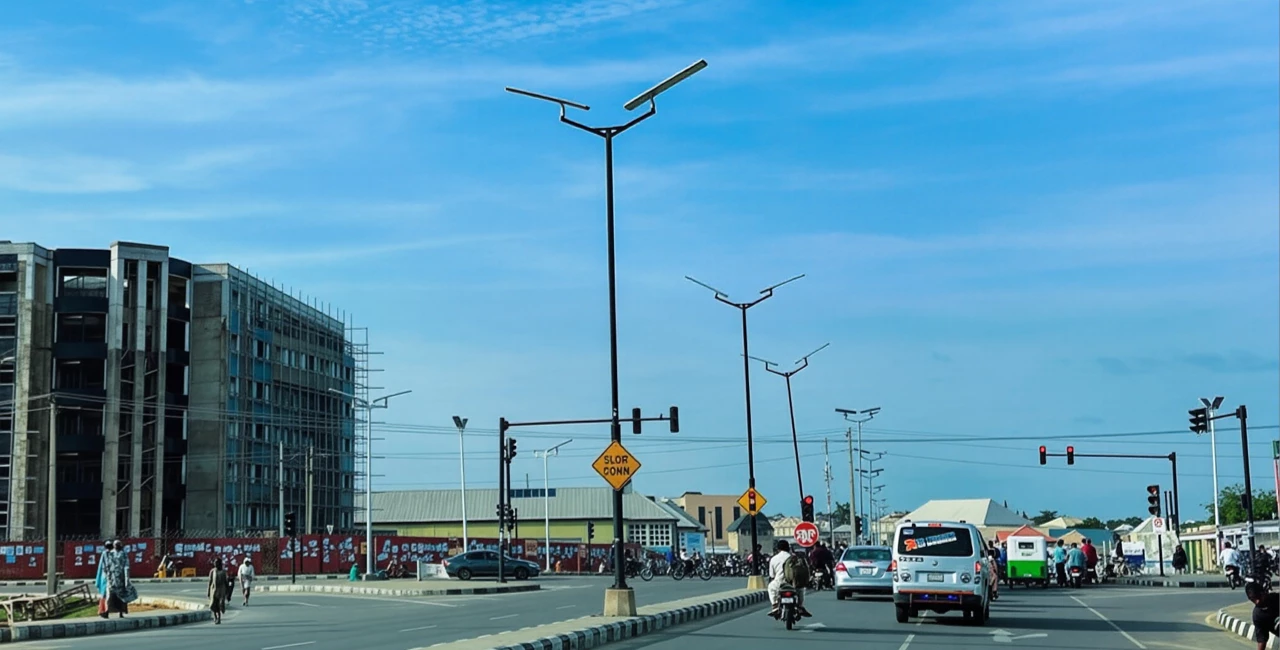
Nigeria's road network spans everything from dense Lagos arterial roads to unlit rural highways with no nearby grid connection, and each of these contexts calls for a different solar street light specification. This guide covers what government agencies, EPC contractors, and distributors sourcing for Nigerian projects need to know: which wattage and pole height suit Nigeria's road classifications; how to size battery autonomy for Nigeria's rainy season; why grid reliability makes solar an increasingly practical choice outside major cities; what corrosion protection matters in coastal states like Lagos and Rivers; and what to look for in a supplier with genuine Nigerian project experience—so you can specify a system that performs reliably across Nigeria's diverse climate and infrastructure conditions.

Best Solar Street Lights for Nigeria: Buying Guide 2026
Nigeria has become one of the largest markets for solar street lighting in Africa, driven by a combination of expanding road infrastructure, inconsistent grid reliability outside major urban centers, and government programs actively pushing off-grid and renewable energy solutions. But "solar street light" isn't a single product—a specification suited to a Lagos expressway performs very differently on a rural access road in Kano State, and buyers who treat Nigeria as a single uniform market often end up with underperforming systems.
This guide covers what to actually check before ordering: wattage and pole height for Nigeria's road types, battery sizing for the rainy season, why grid reliability matters to the buying decision, climate and corrosion considerations across Nigeria's coastal and inland regions, and what separates a reliable supplier from one offering only lab-condition specifications.
Why Nigeria's Solar Street Lighting Market Looks the Way It Does
Nigeria's power grid, managed through a mix of federal and private distribution companies, has long struggled with consistent supply outside Lagos and a handful of other major cities. For street lighting specifically, this means grid-connected systems in many parts of the country are exposed to frequent outages—a serious safety and security concern for road lighting, which is precisely the situation solar street lighting is designed to solve, since it operates independently of grid reliability entirely.
At the same time, the Federal Government's Rural Electrification Agency (REA) has actively promoted off-grid and solar-based electrification programs, including street and community lighting initiatives, across underserved states. This policy direction, combined with the practical grid reliability gap, has made solar street lighting the default choice for a growing share of Nigeria's new road infrastructure projects — from state government road upgrades to federal highway lighting programs.
Wattage and Pole Height for Nigeria's Road Types
Nigeria's road network spans a wide range of classifications, and wattage should follow the road type rather than a generic "Africa" default:
- Residential streets and estate roads: shorter poles (3-4m) with lower wattage fixtures, common across urban residential developments in Lagos, Abuja, and Port Harcourt
- Secondary and local government roads: mid-range poles (5-6m), the most common specification across state-level road upgrade projects
- State and federal highways: taller poles (8-10m) with higher wattage, used on major arterial roads and expressways such as sections of the Lagos-Ibadan corridor
- Major interchanges and toll plazas: the tallest pole heights (10-12m), used where wide area coverage and higher lux levels are required for safety at high-traffic junctions
As with any project, the exact wattage should ultimately be confirmed through a photometric layout calculation rather than a generic table—see our complete guide to choosing the right solar street light for how to work through that sizing process step by step.
Battery Autonomy: Sizing for Nigeria's Rainy Season
Nigeria's climate varies significantly by region—the south experiences a pronounced rainy season roughly from April through October, with the southeast and Niger Delta region receiving especially heavy rainfall, while the north has a shorter rainy season and more consistent sun exposure through much of the year. This regional variation matters directly for battery sizing: a system specified with minimal autonomy margin based on national average sunlight hours can underperform badly during an unusually long or heavy rainy season in the south, even if the same specification performs fine in the north.
For most Nigerian projects, sizing battery autonomy for 3-5 consecutive low-sun days is a reasonable baseline, with projects in the southern coastal states and Niger Delta region generally benefiting from sizing toward the higher end of that range given the more intense and prolonged rainy season in those areas.
Why Grid Reliability Makes Solar a Practical Default Outside Major Cities
For a genuinely honest comparison of the economics involved, see our solar vs. grid street light cost comparison, which breaks down the full total cost of ownership picture rather than just upfront price. In the Nigerian context specifically, the calculation is often more heavily weighted toward solar than in markets with more reliable grid infrastructure for two compounding reasons: grid extension to reach newer or peri-urban roads can be costly and slow to approve, and even where grid connection exists, frequent outages mean connected lighting networks go dark unpredictably—a genuine safety concern for road users and a reliability gap that solar street lighting avoids by design.
Climate and Corrosion Considerations by Region
Nigeria's coastline—running through Lagos, Ogun, Delta, Bayelsa, and Rivers States—brings salt-laden air that accelerates corrosion on unprotected poles and housings faster than inland installations experience. Projects in these coastal states should specifically confirm galvanized or marine-grade pole coating and corrosion-resistant hardware, rather than relying on a standard inland specification.
Inland and northern states face a different climate challenge: higher ambient temperatures and dust, particularly during the Harmattan season, which can reduce solar panel charging efficiency if panels aren't installed at an angle that sheds dust effectively and can accelerate battery degradation in poorly ventilated housings.
What to Check in a Supplier for a Nigerian Project
A few Nigeria-specific questions are worth asking any supplier before committing to a large order:
- Do they have verified project references within Nigeria specifically — not just generic "Africa" case studies — ideally in a climate zone similar to your project's location?
- Can they confirm corrosion protection specifications appropriate for coastal states, if your project is in Lagos, Rivers, or another coastal region?
- Is battery autonomy sized with Nigeria's regional rainy season patterns in mind, rather than a generic continental average?
- Do they understand Nigerian import, customs, and logistics requirements for delivering and supporting a project at scale?
- Can they provide documentation suitable for Nigerian government or EPC tender requirements, including relevant certifications?
Frequently Asked Questions
What wattage solar street light is best for Nigerian highways?
Nigerian highways and expressways typically call for higher-wattage fixtures on 8-10m poles, though the exact figure depends on a photometric layout calculation for the specific road's lux requirements and traffic classification.
How long do solar street lights last in Nigeria's climate?
With appropriate corrosion protection for coastal areas and battery autonomy sized for the regional rainy season, solar street lights can perform reliably for many years across Nigeria's diverse climate zones—the key is matching the specification to the specific region rather than using a single national default.
Is solar street lighting reliable during Nigeria's rainy season?
Yes, provided the system is sized with sufficient battery autonomy—generally 3-5 days or more in Nigeria's southern and coastal states—to cover extended cloudy or heavy rainfall periods.
Why are more Nigerian government projects choosing solar over grid-connected street lighting?
Grid reliability outside major cities remains inconsistent, and grid extension to newer or peri-urban roads can be slow and costly. Solar street lighting avoids both issues, which combined with active government support for off-grid electrification has made it an increasingly practical default for new road lighting projects.
Do coastal Nigerian cities like Lagos and Port Harcourt need special solar street light specifications?
Yes—coastal, high-salinity air accelerates corrosion, so poles and hardware in these areas should carry galvanized or marine-grade protection rather than a standard inland specification.
What certifications should a solar street light supplier provide for a Nigerian government tender?
Requirements vary by tender but commonly include documentation covering LED driver safety, battery safety, IP ingress protection ratings, and photometric performance testing—confirm specific requirements with the procuring agency before finalizing a supplier.
Final Thought
Nigeria isn't one lighting market—it's several, shaped by regional rainfall patterns, coastal versus inland climate exposure, and road classification. A specification that performs well on a Lagos expressway may be over- or undersized for a rural access road in a different state. Working from your specific road type, region, and climate—rather than a generic country-level assumption—is what separates a solar street lighting project that performs reliably for years from one that needs early rework.
Looking to specify solar street lights for a project in Nigeria? Contact our team for a free recommendation based on your state, road type, and project scale, or browse our full product range to see current specifications.
Get a Configuration Quote
Please let us know your specific application scenario and product requirements—we will send you a detailed product specifications list and a reference quote within 24 hours.
Products
mentioned in this Blog
Blog
Country Market Insights
More Blogs

How to Choose the Right Solar Street Light System
Choosing the right solar street light system is essential for achieving reliable outdoor lighting performance, long battery lifespan, and stable nighttime illumination.
Whether the project is for municipal roads, highways, industrial parks, villages, commercial spaces, or public infrastructure, selecting the proper solar street lighting configuration directly affects energy efficiency, installation costs, maintenance requirements, and long-term operational stability.
This guide explains the key factors that should be considered when choosing a solar street lighting system for different outdoor applications and environmental conditions.

Solar Street Light Cost Analysis and ROI Guide
For many years, solar street lighting was often viewed as a niche solution mainly used in remote villages or small off-grid applications.
That perception has changed rapidly.
Today, solar street lighting systems are being deployed across municipal roads, highways, industrial parks, residential communities, mining areas, and large-scale infrastructure projects worldwide.
The reason is no longer only environmental sustainability.
It is economics.
As electricity prices continue rising and infrastructure construction becomes more expensive, governments, contractors, and developers are paying closer attention to long-term operational costs instead of simply comparing upfront equipment pricing.
And this is where solar street lighting starts becoming financially attractive.
At first glance, many buyers still assume solar street lights are expensive.
After all, a complete system includes:
- • solar panels
- • lithium batteries
- • LED fixtures
- • intelligent controllers
- • structural mounting systems
Compared to a conventional street lamp fixture alone, the initial quotation may appear significantly higher.
But experienced infrastructure planners rarely evaluate a project based only on fixture cost.
Because in real-world roadway projects, the lighting fixture is often only a small part of the total investment.

MPPT vs PWM Controllers for Solar Street Lighting Systems
The solar charge controller is one of the most critical components in a solar street lighting system. It directly affects charging efficiency, battery lifespan, and system reliability.
Two commonly used technologies are MPPT (Maximum Power Point Tracking) and PWM (Pulse Width Modulation) controllers.
This article explains their differences and helps you choose the right solution for solar street lighting projects.
Explore More Professional Solar Project Insights
We have more in-depth industry reports, large-scale project cases, energy-saving transformation schemes and wholesale cooperation policies.
Contact us to unlock exclusive B2B cooperation value.
The messenger of light & power conversion.
© 2026 Queneng Light
 Jason Qiu
Queneng
Queneng
Queneng
Queneng