
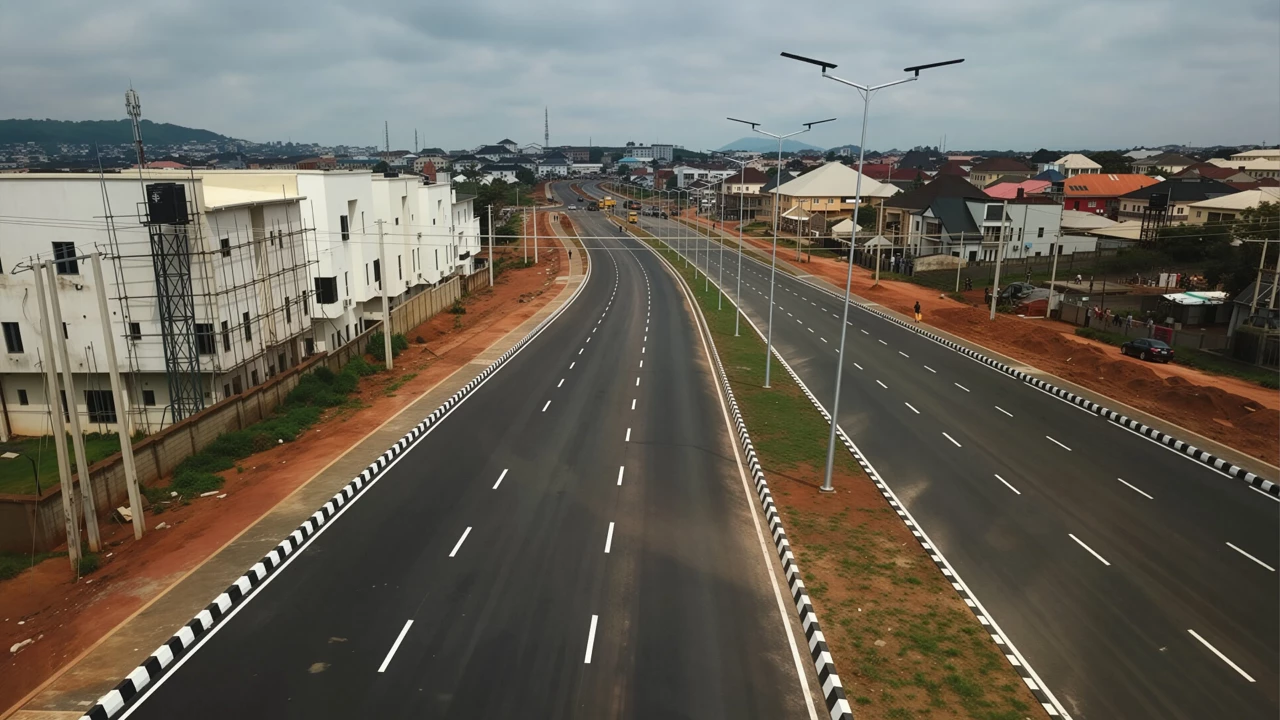

Road lighting tenders and engineering specifications routinely reference "M1" or "M3" without explaining what those labels actually mean or where the numbers come from—and getting the classification wrong on a bid can mean a rejected submission or an underperforming installation. This reference guide explains where the M-class system originates, what each class actually requires in measurable terms, how a road gets assigned to a class in the first place, and how the classification connects to the wattage and pole spacing decisions you'll eventually make for a solar street lighting project—written for engineers, EPC bid teams, and government buyers who need to work with these standards directly rather than take a supplier's word for it.
- A Practical Guide to M1–M5 Road Lighting Classes
- Where the M-Class System Comes From
- What Each M-Class Actually Requires
- How a Road Gets Assigned to a Class
- From Classification to Specification: What This Means for Solar Street Lighting
- Common Mistakes in Tender Responses
- A Quick Reference for Common Road Types
- Frequently Asked Questions
- Final Thought

A Practical Guide to M1–M5 Road Lighting Classes
Open almost any road lighting tender document and you'll find a line specifying "M2" or "M4" as if it were self-explanatory. For engineers who work with these standards daily, it is. For everyone else on a bid team—procurement officers, EPC project managers, and distributors preparing a proposal—it's a label that gets copied from one document to the next without anyone quite explaining where the number comes from or what happens if you get it wrong.
This is a reference guide to the M-class system: what it is, where it comes from, what each class requires in measurable terms, and how it should shape the solar street light specification you actually submit.
Where the M-Class System Comes From
The M-class system originates from lighting design guidance developed by the International Commission on Illumination (CIE) and was later incorporated into the European standard EN 13201, which is now widely referenced—directly or as a model—in road lighting tenders well beyond Europe, including many government and donor-financed projects across Africa. Alongside the M classes (for motorized traffic routes), the same standard defines C classes for conflict zones like intersections and roundabouts, and P classes for pedestrian and low-speed shared paths. This guide focuses on the M classes specifically, since they govern the majority of solar street lighting specifications for roads.
What Each M-Class Actually Requires
Unlike a simple "brighter is better" scale, each M-class defines a specific combination of measurable lighting performance criteria—not just how much light reaches the road surface, but how evenly it's distributed and how much glare is permitted. The three criteria that matter most:
- Average luminance — how bright the road surface appears to a driver, measured in candela per square meter (cd/m²).
- Overall uniformity — how evenly that brightness is distributed across the road, expressed as a ratio between the minimum and average luminance.
- Longitudinal uniformity — how consistent the brightness is along the direction of travel, which affects how comfortable the lighting feels as a driver moves along the road.
As the class number decreases from M6 toward M1, the performance requirement increases — M1 is the most demanding classification in the series, reserved for the highest-speed, highest-volume traffic routes, while M5 and M6 apply to lower-speed, lower-complexity roads. This is a common point of confusion: a "higher" class number does not mean brighter lighting—it means the opposite.
How a Road Gets Assigned to a Class
The classification isn't a subjective judgment call — it's derived from a defined set of road characteristics, each contributing a weighted value. Factors typically considered include:
- The design or posted speed limit of the road
- Traffic volume and composition (proportion of motorized vs. mixed traffic)
- Whether traffic lanes are physically separated
- The density of junctions and the presence of traffic signals
- Ambient area brightness (an urban road with substantial surrounding light differs from an unlit rural corridor)
- Whether parking is permitted along the route
These factors are combined into a scoring calculation that determines the appropriate class for a specific road segment. In practice, this calculation is normally performed once at the road design stage — by a traffic engineer or the awarding authority — and the resulting class is then stated directly in the tender or specification document. For most solar street lighting suppliers and EPC contractors, the relevant task isn't performing this classification calculation from scratch but correctly translating a stated class into a wattage, pole height, and spacing specification that meets it.
From Classification to Specification: What This Means for Solar Street Lighting
This is where the standard connects directly to a purchasing decision. A stated M-class doesn't specify a wattage or a pole height—it specifies a lighting performance outcome, and it's the job of a photometric layout (typically produced in software such as DIALux) to work out which combination of fixture wattage, mounting height, and pole spacing actually achieves that outcome on your specific road geometry. See our DIALux lighting design service for how we produce this layout for a project.
This matters because the same M-class requirement can be met by different combinations of wattage and spacing — wider pole spacing generally requires higher wattage or taller mounting height to maintain the same luminance and uniformity, while tighter spacing can sometimes allow a lower-wattage fixture to meet the same class. For solar street lighting specifically, this trade-off has a second-order effect worth flagging early in a bid: higher wattage fixtures generally require larger solar panels and batteries to maintain the same autonomy, so an inefficient pole-spacing plan doesn't just cost more on poles—it can meaningfully increase the solar and battery cost per kilometer as well. For a full walkthrough of how wattage, pole height, and battery sizing interact, see our guide to choosing the right solar street light.
Common Mistakes in Tender Responses
A few recurring issues show up in bid submissions that reference M-class standards:
- Quoting a fixture's wattage without confirming it meets the stated class's luminance and uniformity requirements for the actual pole spacing proposed—wattage alone doesn't guarantee compliance.
- Submitting a photometric report calculated for a different pole spacing or mounting height than what's actually proposed in the bid, which can cause a technically valid product to fail evaluation on paperwork grounds alone.
- Treating uniformity requirements as secondary to brightness — a road that meets the average luminance figure but fails the uniformity ratio will still fail the class requirement, since uneven lighting creates genuine safety issues even when the average is adequate.
- Assuming a class standard for one country's tender automatically transfers to a project elsewhere—while the M-class system itself is broadly consistent, some countries apply national adaptations or alternative standards (such as those used in North American practice), so confirming which specific standard governs a given tender is worth doing explicitly rather than assuming.
More common questions on this topic are covered in our engineering design FAQ.
A Quick Reference for Common Road Types
While the actual class assignment always depends on the specific factors listed earlier, these are commonly observed associations in practice:
| Road Type | Commonly Associated Class | General Characteristics |
|---|---|---|
| High-speed highways, motorways | M1 | Highest traffic speed and volume, most demanding lighting requirement |
| Major arterial roads, primary routes | M2–M3 | High traffic volume, moderate to high speed |
| Secondary roads, urban collector roads | M3–M4 | Moderate traffic volume and speed |
| Local roads, residential streets with vehicle access | M4–M5 | Lower speed and volume |
| Minor access roads, low-traffic residential areas | M5–M6 | Lowest traffic complexity in the M series |
Treat this table as a starting orientation, not a substitute for the actual classification calculation or a stated tender requirement.
Frequently Asked Questions
Does a lower M-class number mean brighter or dimmer lighting?
A lower number means a more demanding requirement—M1 requires the highest luminance and strictest uniformity of the M series, while M5 and M6 apply to lower-speed, lower-complexity roads with less demanding requirements.
Who decides which M-class applies to a specific road?
The classification is typically determined at the road design stage by a traffic engineer or the awarding government authority, based on factors like design speed, traffic volume, and junction density, and is then stated in the tender or specification document.
Can one solar street light wattage satisfy multiple M-classes?
Not directly—the same fixture can potentially satisfy different classes depending on the pole height and spacing it's installed at, since luminance and uniformity depend on the combination of fixture output and physical layout, not wattage alone.
Is the M-class system used outside Europe?
Yes—while it originates from CIE guidance and EN 13201, the same or closely adapted classification frameworks are referenced in road lighting tenders across many African and international markets, often directly or as a stated model within national specifications.
What happens if a bid submission doesn't meet the stated M-class?
Outcomes vary by tender, but non-compliance can result in technical disqualification, a request for resubmission, or contractual liability if the discrepancy is discovered after installation—confirming compliance through an actual photometric calculation before submission is the safer approach.
Final Thought
The M-class system exists to turn "How bright should this road be?" into a measurable, verifiable requirement—but the label alone tells you what outcome is needed, not how to achieve it. That translation step, from a stated class to an actual wattage, pole height, and spacing plan, is where photometric design work earns its place in a serious bid, and it's the difference between a paper specification that looks compliant and a road that actually performs the way the standard intends.
Need help translating an M-class requirement into a solar street light specification for your project? Contact our engineering team for a free photometric review, or explore our full product range to see current wattage and pole height options.
Get a Configuration Quote
Please let us know your specific application scenario and product requirements—we will send you a detailed product specifications list and a reference quote within 24 hours.
Products related to this blog

How to Choose the Right Solar Street Light System
Choosing the right solar street light system is essential for achieving reliable outdoor lighting performance, long battery lifespan, and stable nighttime illumination.
Whether the project is for municipal roads, highways, industrial parks, villages, commercial spaces, or public infrastructure, selecting the proper solar street lighting configuration directly affects energy efficiency, installation costs, maintenance requirements, and long-term operational stability.
This guide explains the key factors that should be considered when choosing a solar street lighting system for different outdoor applications and environmental conditions.

Solar Street Light Cost Analysis and ROI Guide
For many years, solar street lighting was often viewed as a niche solution mainly used in remote villages or small off-grid applications.
That perception has changed rapidly.
Today, solar street lighting systems are being deployed across municipal roads, highways, industrial parks, residential communities, mining areas, and large-scale infrastructure projects worldwide.
The reason is no longer only environmental sustainability.
It is economics.
As electricity prices continue rising and infrastructure construction becomes more expensive, governments, contractors, and developers are paying closer attention to long-term operational costs instead of simply comparing upfront equipment pricing.
And this is where solar street lighting starts becoming financially attractive.
At first glance, many buyers still assume solar street lights are expensive.
After all, a complete system includes:
- • solar panels
- • lithium batteries
- • LED fixtures
- • intelligent controllers
- • structural mounting systems
Compared to a conventional street lamp fixture alone, the initial quotation may appear significantly higher.
But experienced infrastructure planners rarely evaluate a project based only on fixture cost.
Because in real-world roadway projects, the lighting fixture is often only a small part of the total investment.

MPPT vs PWM Controllers for Solar Street Lighting Systems
The solar charge controller is one of the most critical components in a solar street lighting system. It directly affects charging efficiency, battery lifespan, and system reliability.
Two commonly used technologies are MPPT (Maximum Power Point Tracking) and PWM (Pulse Width Modulation) controllers.
This article explains their differences and helps you choose the right solution for solar street lighting projects.

Solar Street Light vs Grid Street Light: Which Costs Less Over 10 Years?
An upfront price only tells half the story. Here's the full cost breakdown — installation, electricity bills, maintenance, and reliability — so you can see which option actually costs less over your project's lifetime.

Solar Street Light Installation Guide for Roads and Infrastructure Projects
Installing solar street lights is often described as a straightforward process.
On paper, it looks simple: assemble the pole, fix the solar panel, connect the battery, and test the system.
But in real infrastructure projects, installation is rarely that clean.
Once engineers arrive on site, they are usually dealing with uneven road conditions, unexpected shading issues, unstable soil for foundations, transportation limitations, and last-minute design adjustments based on actual field conditions.
This is why installation quality often determines the real lifespan and performance of a solar street lighting system more than product specifications alone.
A well-designed system can still perform poorly if installation is not handled correctly. On the other hand, a properly installed system can often outperform expectations even in challenging environments.

Best Solar Street Lights for Nigeria: Buying Guide 2026
Nigeria's road network spans everything from dense Lagos arterial roads to unlit rural highways with no nearby grid connection, and each of these contexts calls for a different solar street light specification. This guide covers what government agencies, EPC contractors, and distributors sourcing for Nigerian projects need to know: which wattage and pole height suit Nigeria's road classifications; how to size battery autonomy for Nigeria's rainy season; why grid reliability makes solar an increasingly practical choice outside major cities; what corrosion protection matters in coastal states like Lagos and Rivers; and what to look for in a supplier with genuine Nigerian project experience—so you can specify a system that performs reliably across Nigeria's diverse climate and infrastructure conditions.
Tailored Solar Street Light Solutions for Your Projects
Request Installation Consultation
View more of our products suitable for installation in African countries and regions.

30W–120W All-in-One Solar Street Light for Residential & Rural Roads | QN-YY
QN-YY is a compact all-in-one solar street light solution developed by Queneng for decentralized outdoor lighting applications.
Combining a high-efficiency solar panel, LED lighting module, LiFePO₄ battery, and intelligent controller into one integrated unit, QN-YY simplifies installation while providing reliable illumination performance for residential roads, rural communities, pathways, and small infrastructure projects.
The QN-YY is available with multiple configurations, including QN-YY130, QN-YY140, QN-YY160, QN-YY180, and QN-YY1110, allowing project developers to select suitable power options according to road width, installation height, and lighting requirements.
The messenger of light & power conversion.
© 2026 Queneng Light
 Jason Qiu
Queneng
Queneng
Queneng
Queneng